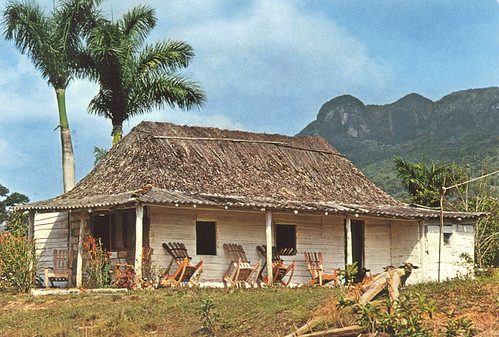
A bohío is a simple dwelling, native to the archipelago known to the world today as the West Indies.
The signature physical feature of a bohío is its thatched palm-frond roof. Generations of Western innovations have thus far failed to create a more effective method of keeping the tropical downpours typical to the Caribbean from the insides of these timeless abodes.
The bohío served as the basic component of the Antillean communities for centuries before the arrival of avaricious conquerors. A bohío represented an individual family's special but not exclusive corner in a community that relied on its interactions with others: islands, villages, clans, families, people, animals, plants, all of nature.
The bohío was the building block upon which the original inhabitants of the Caribbean islands lived their simple lives in communion with the world around them.
The bohío lives on today in every part of the West Indies and in the heart and soul of every West Indian - no matter where he or she may live.
This is just one bohío and, like all bohíos, you are welcome here.
Saturday, October 10, 2015
Thursday, January 24, 2013
democracia es, para mi,.....
Democracy, it seems to me, is probably more about how we get along with folks we don't agree with than how we agree with folks we get along with. - me

Sunday, July 15, 2012
Food trucks

Food trucks are great but wait until McDonald's, Burger King, Wendy's, Kentucky Fried Chicken, Taco Bell, et al roll out theirs ... and woe unto everyone when WalMart's food trucks run everyone else out of food truck business.
Monday, July 12, 2010
'There is no Hall of Fame' - How LeBron James et al Owe Curt Flood a Debt of Gratitude
'There is no Hall of Fame'
How LeBron James et al Owe Curt Flood a Debt of Gratitude

by hassan Pérez
The very recent LeBron James "story" of free agency and greener pastures and unrestrained hate from a scorned rich man has been told and retold and spun in many different directions and will probably continue to be told and spun for some time to come.
Yet, one angle this writer has seen very little of is the "seed" angle. If the multimillion dollar contract James signed with the Miami Heat is the fruit, then the courageous stand made by Curt Flood forty years earlier is the seed.
In January of 1970, when many of his peers in Major League Baseball were enjoying their last few weeks of winter break before the start of spring training, Flood - who at the time was an outstanding veteran outfielder for one of American baseball's most popular franchises, the St. Louis Cardinals - sued Major League Baseball. At issue was the infamous reserve clause which effectively placed the power of managing a player's movement within the big leagues exclusively in the hands of the owners of the member ball clubs. Players had no rights, no leverage, no bargaining power over where they played, when or if or to whom they were traded, how much they made, et cetera and Flood argued that those policies, that clause was in violation of the 13th Amendment of the Constitution. Flood's position was that the reserve clause perpetuated "involuntary servitude."
Even casual sports fans know that Muhammad Ali paid a great price for his stand against the VietNam War as his titles and ability to even earn money fighting were stripped away. Curt Flood, too, suffered greatly for his stand. Initial reaction to his suit against Major League Baseball was strong, virulent, and against him. As Flood recounted in his book, The Way It Is, many powerful forces worked together to try to demonize him to millions of Americans who, like Flood, worked hard and wanted to be treated fairly at his place of employment:
"If the newspaper was typical, it lied that a victory for Flood would mean the collapse of our national pastime. God prophaned! Flag desecrated! Motherhood defiled! Apple pie blasphemed!" - Curt Flood
Flood took the case to the United Supreme Court where, in a 1972 decision, ruled in favor of Major League Baseball yet, by 1975, the seed planted by Flood began to sprout.
Fast forward back to 2010 and the angry, spiteful, vindictive, emotionally unstable words launched by Dan Gilbert, owner of the NBA's Cleveland Cavaliers, against James in a typed temper tantrum that was splashed on his team's home page shortly after James announced his decision to exercise his rights as a free agent and work where he wanted to. Gilbert's letter was a forceful, scornful tirade against a player who had honored the contract he signed with the Cleveland Cavaliers seven years earlier - as a teenager just coming out of high school.
Although some support and even applaud Gilbert's hysterical fit of filth and venom, many have stepped forward to condemn it in plain language. On the "Florida Caribbean Sports Line" on Miami's WZAB radio, host Oliver Solomon and others said that Gilbert's classless display was deserving of a fine by the NBA. In a statement released by the Rainbow/PUSH Coalition, the Reverend Jesse Jackson called Gilbert to task saying that Gilbert "speaks as an owner of LeBron and not the owner of the Cleveland Cavaliers. His feelings of betrayal personify a slave master mentality. He sees LeBron as a runaway slave."
*Gilbert is a modern day Massa who continues to demonstrate little respect for the workers that help make him richer and richer: Gilbert is founder and Chairman of QuickenLoans, a company that as recently as 2007 was responsible for tens of billions of dollars in mortgages, which is the defendant in an ongoing class action lawsuit filed by workers who maintain that the company grossly violated terms of the Fair Labor Labor Act by not paying overtime.
Indeed even the reactions of many people - both in and out of Cleveland - smack of a residual paternalistic mindset that has been conditioned to believe that some members of our society, in enriching others, are perpetually indebted to those being enriched. It reminds one of the character of Bob Stone in Jean Toomer's short story "Blood Burning Moon" in which Stone, a white overseer, seethed at being in competition for the affection of Louisa, a young Black woman. Stone, we soon learn, was not upset the competition but, instead, was outraged over being in competition with a Black man, Tom Burwell:
"Who ever heard of being afraid of a ni**er? Cartwell had told him that Tom went with Louisa after she reached home. No sir. No ni**er had ever been with his girl. He'd like to see one try." - story
James is being subjected to an outrage today that has the same roots as the outrage that was hurled at Flood 40 years ago. Those roots have grown into trees, trees with branches. The branches were evident in their absence from the funeral of Flood in Los Angeles in January 1997 when none of the contemporary players who were enjoying the fruits borne of the seed so painfully planted by Flood came to pay his respects.
The significance of the moment and the players so painfully absent from said moment was not lost on Marvin Miller, famed former executive director of the Major League Baseball Players' Association. Miller offered the sad truth that "there is no Hall of Fame for people like Curt."
Miller was right. There is no Hall of Fame for Curt Flood - only benefactors from his fight and virulent attackers of those exercising their rights.
Friday, June 04, 2010
Jamaican Juneteenth
"Jamaican Juneteenth" por hassan Pérez
It took more than two years for them to get the news;
Two more years of inhuman abuse.
Because they were in Texas, they were the last to know -
Ironic because slavery was illegal when Texas part of Mexico.
That same year, on an island in the Caribbean Sea,
Another chapter was written in the book of liberty.
Freedmen in Jamaica were subjected to injustice after injustice
All because they believed Victoria when she said "trust us."
Because the crown would not let them have their say,
Paul Bogle bravely marched on Morant Bay.
As boys in blue moved in to replace gray in the South,
Bogle's body swung from a noose in the burnt-out courthouse.
A century later, Bogle was hailed as the first great Jamaican
While Blacks in Texas still hear the phrase, "the South shall rise again!"
Paul Bogle fought for his neighbors because they were human.
Robert E. Lee fought to save the South from economic ruin.
No matter how hard they try to convince us,
Things don't really change deep in the heart of Texas:
Shiny bumper stickers emblazoned with the stars and bars
Neatly affixed to the rear bumpers of brand new sports cars.
For some folks, the 19th may be just another day
But I'm spending Juneteenth in Morant Bay.
© copyright hassan Pérez 2004 - ® all rights reserved

Tuesday, January 12, 2010
Toma chocolate, Pague lo que debes
Growing up in the United States, I've seen a lot of fads come and go and I know enough of this country's cultural history to know that there were many here-today-gone-tomorrow fads that were all but forgotten by the time I was born. Today's "hit" will be barely a memory next week, much less next year. This is especially true for quirky cultural sensations that cross - however momentarily - the many dizzying social lines in this country.
For example, twenty years ago this week, M.C. Hammer's "Can't Touch This" was officially released to the record-buying public in North America. It, of course, was a hit but for how long? Play that song at a party now and you might get some enthusiastic responses but it depends on so many things: the age demographic of the recepients, even the ethnic orientation of the listeners. Real talk here: the response to that song will not be the same in a Waco, Texas honkey-tonk or an Elks ball in Butte, Montana as it may be at an alumni dance at North Carolina A&T University in Greensboro.
That is not a knock as much as an observation of how compartmentalized - across generational, linguistic, ethnic, ideological, geographical, socioeconomic lines - culture is the United States.
Although I was raised in the United States, my family is not from here - they are from Cuba.
Cuba, to be sure, has had its own share of fads that have come and gone. There are, however, some staples that are enjoyed and celebrated by Cubans of all ages, in every corner of the world.
The best example of timeless, limitless "resonance" for Cubans is the song "El Bodeguero," composed by legendary flautist Richard Egües of the seemingly immortalt Orquesta Aragon. It matters not where one starts playing this delightful cha cha cha, or even when. Once the familiar notes of D E F G F begin to play, the response is universal ... universally Cuban.

To whit, a video clip showing the creators of "El Bodeguero" (including its composer with exquisite flute riffs) depicts an electricity that can be sensed through the computer screen, over the miles, beyond the years. The audience and artists merge into one, one big hunk of Cuban delight.
This simple song, about a humble shopkeeper who dances amongst his fresh produce, is so beloved by me and the rest of my countrymen that it is almost a national anthem to us. It is just one of those unique expressions of what we refer to as our Cubanidad.
Now, if you'll excuse me, I think I will forget that I don't really dance well and indulge in a cha cha cha.
Thursday, December 17, 2009
Saturday, December 05, 2009
Elian & El Duque, Revisited
Saludos!
As this decade draws to a close, i believe it is important to reflect upon lessons learned at the onset of not only this decade but also this still new millenium. It is also important to revisit lessons that were not learned by us. To whit, just because we are being bribed with nicer things does not change the fact that our enemies are still trying to seduce us away from our values.
Last week marked the tenth anniversary of the beginning of the sad case of Elian Gonzalez, a small child cast adrift in the same ravenous ocean that swallowed his mother and their companions right before his innocent eyes. Before long, the child would be rescued only to be cast adrift in a greater sea of avarice: the political, economic, social, and moral wasteland known as Miami, USA, den of democratic inequity and lair of murderous and elitist opportunists.
Elian, however, was not the only seemingly innocent recently-arrived Cuban to be consumed by the dysfunctional force of la Yuma.
Just a few weeks before Elian's mother stole away with him in the darkness of that autumn night, Orlando Hernandez was being celebrated as a heroe among the people in Miami who call themselves "Cuban" in spite of hating Cuba and its people (which, prior to his much-bally-hooed desertion, included Hernandez, too). El Duque, as Hernandez is also known, did not just leave his team mates and his neighbors behind in Cuba, he was pitching in the major leagues and he won a World Series - with the New York Yankees no less! The irony was hard to resist for the enemies of Cuba in Miami.
By the time of the first month of the new decade (the one we, God willing, will be saying good-bye to within a few weeks), the first month of the new century, the first month of the new millenium arrived, we would all get a chance to see to what degree the archenemies of dignity and liberty would go to extract maximum publicity from their salt-water souvenirs.
The following essay was written at the close of that month and it does today what it did then: serve as a chronicler and prosecutor of the seducer and, in the case of Hernandez, the willingly seduced. The indictment, written by my dear friend and mentor Alberto Jones, has more relevance now as the fruits offered by the serpent now are much more alluring than those on display ten short years ago. Thus, this essay is not only still relevant but it warns us all with greater urgency.
I wish all of you, all of us, dignity and fraternity and solidarity now and in the future before us.
Un abrazo,
hassan
.
.
Sunday, January 23, 2000
Elián's Tragedy and the Traiterous Behavior of El Duke
"Elián's Tragedy and the Traiterous Behavior of El Duke"
por Alberto Jones
January 23, 2000
*originally posted on afrocubaweb.com
During the summer of 1966, as a student in Germany, I went through my life most revolting experience, when I visited Buchenwald, one of Nazi Germany best known concentration camp. Without ever being there, seeing the ovens, the human skin lamp shades, the films, it would not be possible to fully capture the bestiality in many of us.
But most difficult to understand was that this extermination complex was located a few miles from Weimer, the highly educated, cultural center of Germany, where the cream of that society, took part regularly in music or arts festivals, pretending nothing was wrong or intentionally remaining silent, sanctifying such heinous deed.
Millions of people paid the ultimate price, because of our complacency, lack of courage or complicity. Sixty years after, it appears we have learned very little from this tragedy or as it was then, we are too busy, too selfish to care about the suffering of others.
The tragic events surrounding 6 year old Elian Gonzalez, who was found Thanksgiving Day clinging to an inner tube off the shores of South Florida after the drowning death of his mother and 9 others involved in an ill-fated, alien smuggling attempt, have shocked the conscience of millions of people around the world.
This child, who may have suffered permanent psychological trauma and more physical pain than most of us in our lifetime, continues to be forcibly retained in a foreign environment, surrounded by people he has never seen before, turned into a celebrity and plunged into a media frenzy by the heartless, vengeful, ultra-right-wing Cuban American pseudo-politicians in Miami and New Jersey.
In order to explain their absurd position, they are presenting the most bizarre, baseless arguments; as they perceive the well being of the child in direct relation with the availability of Nintendo, Tommy's or McDonalds, creating an artificial "Dream World" around him, which incidentally, does not apply to hundreds of other Cubans, Haitians, Afro-Americans or poor Anglo children in Miami and every other city in this country.
But what makes this action more despicable, is that they are knowingly, systematically applying against this innocent child, well established and universally accepted theories of "Conditioned Reflexes," which was demonstrated many years ago by Pavlov and others.
By showering this child with an ample variety of foods, garments, toys, Disney World etc., they are imprinting in his young brain a world he will no longer have, as soon as he is returned to his father, creating a vacuum that will be replaced by withdrawal, anxiety, depression, or a socially unfit time bomb, capable of going off any time.
Having been in this world for much longer than I would like to accept, I have experienced first hand, the brutality, cruelty, visciousness that humans are capable of exhibiting. But for the most time, we expect to see these subhuman behavior associated with civil unrest or other types of deranged environment, that may explain in part, such actions.
But to do that in cold blood to a fragile, timid, scarred child, is beyond all humanoid classification of these barbarians disguised as teachers, mothers, politicians, pediatricians, psychologists, sociologists and even clergy!
As an Afro-Cuban, I am deeply troubled by the casual reporting or limited coverage of this horrendous human experience in the Black media. With few exceptions, prominent leaders with the moral standing capable of expressing their disgust, have been conspicuously silent.
But above and beyond the morality of this issue, no other racial/ethnic group in the world, should be more sensitive to any perception of forcefully restraining and separating family members, based upon our own tragic experience in which family members were separated and dispersed throughout this hemisphere.
It must be emphasized also that what is being done to this defenseless child by the Cuban-American community in Miami, is nothing more than a rehash of what they did to the native community in Latin America as of 1492, to the African slaves as of 1512, to the Afro-Cuban community until 1959 in Cuba and to the Afro-American community in South Florida since 1960, which they have subjugated and made hopelessly dependent, inflicting a massive influx of drugs and other social ills.
But if all of the above is nauseating and repugnant, even more so was the spectacle of watching the Three Kings Parade in Miami, in which New York Yankee Afro-Cuban pitcher "El Duke" Hernandez was the Grand Marshall of this event, thereby sanctioning and giving approval to the past behavior of this group of right wing Cuban-Americans.
This individual, through his irresponsible action, has tried to obscure or ignore the horrendous racism, ignorance, poverty, hunger and the deaths of thousands of children through preventible causes inflicted on our people by these criminals when they owned the lives and property in Cuba.
This traitor cannot deny that if he did not feel it himself, he heard from his parents, neighbors, how it was and what these people did to us.
These Miami Cuban-Americans, rightfully driven out of Cuba FOREVER, were the enforcers and perpetrators of our 29% illiteracy rate, 24% infant mortality, segregated neighborhoods, beaches, clubs. They forced us to live in huts without electricity, running water, sewer, no jobs, and openly prohibited us to work in department stores, banks, office settings or even drive a provincial bus.
These are the same individuals that forced Nat King Cole, Josephine Baker and other luminaries, to use the kitchen door in order to enter the night club where they were to perform. These are the same individuals that bragged that their puppet President Batista, was denied entry in the Havana Yatch Club.
These are the same individuals, that when beaches and clubs were integrated in Cuba in 1960,
they UNANIMOUSLY refused to enter to these places and renamed them SOLOVANNICHE. Later, we were able to unscramble this as SOLO VAN NICHE or ONLY WHERE NIGGERS GO!
But what makes more blatant, offensive and painful the irresponsible behavior of "El Duque" is the extensive and proud history of Black Cubans, who since the Ladder Conspiracy against slavery have crafted one of the most dignified, honorable and heroic history in this hemisphere.
No Afro-Cuban can ever forgive the affront to the memory of Antonio Maceo, Guillermon Moncada or Quintin Banderas. Mariana Grajales, the Black mother of the Cuban Nation, who gave the lives of 9 members of her family in the war of independence, may have cried for the first time in her life, to know, that such a THING, could be one of us!
But his indignity has no parallel. Made drunk by the few millions paid to him by his team owners, he feels compelled to be on his knees, to accept his self-inflicted inferiority, to forgive and forget our history.
Jesus Menendez, the sugar industry union leader, with approximately the same or less level of education than this other Personality, but with an absolute sense of dignity, self respect and love for his nation, was called to the White House, -not for the 6 million that is paid to "El Duque"- he was handed a blank, signed, federal check for him to fill out and stop the strike in Cuba. He refused the check, returned to Cuba and under orders "from above" was shot as he detrained in the station in Mazanillo.
Jesus Menendez is another of the endless list of Afro-Cubans heros who Cubans respect, admire and imitates on a daily basis. "El Duque" will be remembered by the Cubans for opposite reasons!
I am forced to admit, that the actions of "El Duque" Hernandez, have created in me the same revolting experience as the one I experienced in Buchenwald 35 years ago and never thought I would ever have to relive!
As this decade draws to a close, i believe it is important to reflect upon lessons learned at the onset of not only this decade but also this still new millenium. It is also important to revisit lessons that were not learned by us. To whit, just because we are being bribed with nicer things does not change the fact that our enemies are still trying to seduce us away from our values.
Last week marked the tenth anniversary of the beginning of the sad case of Elian Gonzalez, a small child cast adrift in the same ravenous ocean that swallowed his mother and their companions right before his innocent eyes. Before long, the child would be rescued only to be cast adrift in a greater sea of avarice: the political, economic, social, and moral wasteland known as Miami, USA, den of democratic inequity and lair of murderous and elitist opportunists.
Elian, however, was not the only seemingly innocent recently-arrived Cuban to be consumed by the dysfunctional force of la Yuma.
Just a few weeks before Elian's mother stole away with him in the darkness of that autumn night, Orlando Hernandez was being celebrated as a heroe among the people in Miami who call themselves "Cuban" in spite of hating Cuba and its people (which, prior to his much-bally-hooed desertion, included Hernandez, too). El Duque, as Hernandez is also known, did not just leave his team mates and his neighbors behind in Cuba, he was pitching in the major leagues and he won a World Series - with the New York Yankees no less! The irony was hard to resist for the enemies of Cuba in Miami.
By the time of the first month of the new decade (the one we, God willing, will be saying good-bye to within a few weeks), the first month of the new century, the first month of the new millenium arrived, we would all get a chance to see to what degree the archenemies of dignity and liberty would go to extract maximum publicity from their salt-water souvenirs.
The following essay was written at the close of that month and it does today what it did then: serve as a chronicler and prosecutor of the seducer and, in the case of Hernandez, the willingly seduced. The indictment, written by my dear friend and mentor Alberto Jones, has more relevance now as the fruits offered by the serpent now are much more alluring than those on display ten short years ago. Thus, this essay is not only still relevant but it warns us all with greater urgency.
I wish all of you, all of us, dignity and fraternity and solidarity now and in the future before us.
Un abrazo,
hassan
* ** ** * * *
..
.
Sunday, January 23, 2000
Elián's Tragedy and the Traiterous Behavior of El Duke
"Elián's Tragedy and the Traiterous Behavior of El Duke"
por Alberto Jones
January 23, 2000
*originally posted on afrocubaweb.com
During the summer of 1966, as a student in Germany, I went through my life most revolting experience, when I visited Buchenwald, one of Nazi Germany best known concentration camp. Without ever being there, seeing the ovens, the human skin lamp shades, the films, it would not be possible to fully capture the bestiality in many of us.
But most difficult to understand was that this extermination complex was located a few miles from Weimer, the highly educated, cultural center of Germany, where the cream of that society, took part regularly in music or arts festivals, pretending nothing was wrong or intentionally remaining silent, sanctifying such heinous deed.
Millions of people paid the ultimate price, because of our complacency, lack of courage or complicity. Sixty years after, it appears we have learned very little from this tragedy or as it was then, we are too busy, too selfish to care about the suffering of others.
The tragic events surrounding 6 year old Elian Gonzalez, who was found Thanksgiving Day clinging to an inner tube off the shores of South Florida after the drowning death of his mother and 9 others involved in an ill-fated, alien smuggling attempt, have shocked the conscience of millions of people around the world.
This child, who may have suffered permanent psychological trauma and more physical pain than most of us in our lifetime, continues to be forcibly retained in a foreign environment, surrounded by people he has never seen before, turned into a celebrity and plunged into a media frenzy by the heartless, vengeful, ultra-right-wing Cuban American pseudo-politicians in Miami and New Jersey.
In order to explain their absurd position, they are presenting the most bizarre, baseless arguments; as they perceive the well being of the child in direct relation with the availability of Nintendo, Tommy's or McDonalds, creating an artificial "Dream World" around him, which incidentally, does not apply to hundreds of other Cubans, Haitians, Afro-Americans or poor Anglo children in Miami and every other city in this country.
But what makes this action more despicable, is that they are knowingly, systematically applying against this innocent child, well established and universally accepted theories of "Conditioned Reflexes," which was demonstrated many years ago by Pavlov and others.
By showering this child with an ample variety of foods, garments, toys, Disney World etc., they are imprinting in his young brain a world he will no longer have, as soon as he is returned to his father, creating a vacuum that will be replaced by withdrawal, anxiety, depression, or a socially unfit time bomb, capable of going off any time.
Having been in this world for much longer than I would like to accept, I have experienced first hand, the brutality, cruelty, visciousness that humans are capable of exhibiting. But for the most time, we expect to see these subhuman behavior associated with civil unrest or other types of deranged environment, that may explain in part, such actions.
But to do that in cold blood to a fragile, timid, scarred child, is beyond all humanoid classification of these barbarians disguised as teachers, mothers, politicians, pediatricians, psychologists, sociologists and even clergy!
As an Afro-Cuban, I am deeply troubled by the casual reporting or limited coverage of this horrendous human experience in the Black media. With few exceptions, prominent leaders with the moral standing capable of expressing their disgust, have been conspicuously silent.
But above and beyond the morality of this issue, no other racial/ethnic group in the world, should be more sensitive to any perception of forcefully restraining and separating family members, based upon our own tragic experience in which family members were separated and dispersed throughout this hemisphere.
It must be emphasized also that what is being done to this defenseless child by the Cuban-American community in Miami, is nothing more than a rehash of what they did to the native community in Latin America as of 1492, to the African slaves as of 1512, to the Afro-Cuban community until 1959 in Cuba and to the Afro-American community in South Florida since 1960, which they have subjugated and made hopelessly dependent, inflicting a massive influx of drugs and other social ills.
But if all of the above is nauseating and repugnant, even more so was the spectacle of watching the Three Kings Parade in Miami, in which New York Yankee Afro-Cuban pitcher "El Duke" Hernandez was the Grand Marshall of this event, thereby sanctioning and giving approval to the past behavior of this group of right wing Cuban-Americans.
This individual, through his irresponsible action, has tried to obscure or ignore the horrendous racism, ignorance, poverty, hunger and the deaths of thousands of children through preventible causes inflicted on our people by these criminals when they owned the lives and property in Cuba.
This traitor cannot deny that if he did not feel it himself, he heard from his parents, neighbors, how it was and what these people did to us.
These Miami Cuban-Americans, rightfully driven out of Cuba FOREVER, were the enforcers and perpetrators of our 29% illiteracy rate, 24% infant mortality, segregated neighborhoods, beaches, clubs. They forced us to live in huts without electricity, running water, sewer, no jobs, and openly prohibited us to work in department stores, banks, office settings or even drive a provincial bus.
These are the same individuals that forced Nat King Cole, Josephine Baker and other luminaries, to use the kitchen door in order to enter the night club where they were to perform. These are the same individuals that bragged that their puppet President Batista, was denied entry in the Havana Yatch Club.
These are the same individuals, that when beaches and clubs were integrated in Cuba in 1960,
they UNANIMOUSLY refused to enter to these places and renamed them SOLOVANNICHE. Later, we were able to unscramble this as SOLO VAN NICHE or ONLY WHERE NIGGERS GO!
But what makes more blatant, offensive and painful the irresponsible behavior of "El Duque" is the extensive and proud history of Black Cubans, who since the Ladder Conspiracy against slavery have crafted one of the most dignified, honorable and heroic history in this hemisphere.
No Afro-Cuban can ever forgive the affront to the memory of Antonio Maceo, Guillermon Moncada or Quintin Banderas. Mariana Grajales, the Black mother of the Cuban Nation, who gave the lives of 9 members of her family in the war of independence, may have cried for the first time in her life, to know, that such a THING, could be one of us!
But his indignity has no parallel. Made drunk by the few millions paid to him by his team owners, he feels compelled to be on his knees, to accept his self-inflicted inferiority, to forgive and forget our history.
Jesus Menendez, the sugar industry union leader, with approximately the same or less level of education than this other Personality, but with an absolute sense of dignity, self respect and love for his nation, was called to the White House, -not for the 6 million that is paid to "El Duque"- he was handed a blank, signed, federal check for him to fill out and stop the strike in Cuba. He refused the check, returned to Cuba and under orders "from above" was shot as he detrained in the station in Mazanillo.
Jesus Menendez is another of the endless list of Afro-Cubans heros who Cubans respect, admire and imitates on a daily basis. "El Duque" will be remembered by the Cubans for opposite reasons!
I am forced to admit, that the actions of "El Duque" Hernandez, have created in me the same revolting experience as the one I experienced in Buchenwald 35 years ago and never thought I would ever have to relive!
Friday, October 30, 2009
A needed 'change' in priorities.
Hey President Obama, instead of giving tax-funded scholarships to military academies, let's have a CHANGE and give tax-funded scholarships to medical students.

An Introduction to 'An Indelible Mark' - The Dr. Alberto Jones Reader

For the past five years, faithful (sometimes random) readers such as yourself have taken time from their schedules to read what i have to share. Most of what i do share is motivated by a desire to inspire and uplift. In particular, i write to bring greater awareness about my people, my culture, my history, my country to an often-times misunderstanding and quite unforgiving world.
A big reason for this online sharing of free-thinking and altruistic affection is my friend and mentor, Dr. Alberto Jones (whom i wrote about in an essay first published in the first year of this online journal).
Alberto has been writing important, powerful testimonials for years now and, after one of our conversations, he suggested in that way that he does that i collect his works in one place. That place is the online Alberto Jones Reader, entitled "An Indelible Mark" (taken from one of his earlier pieces) and i invite you to read it and i invite you to invite others to do the same.
In peace and solidarity,
h a s s a n

Tuesday, October 20, 2009
OMIGWASH!!! V. V. BROWN!!!!!!

Direct from Great Britain, a European favorite, V. V. Brown starts touring here in the US this month with her debut US cd due shortly thereafter. A refreshing change from the played-out, same simple formula of the current "R&B" (repeated & boring) scene in the US, V.V. is ... ORIGINAL!!
.
.
.
For more information on V. V. Brown and her tour dates (in California this month), please click here.
Wednesday, September 16, 2009
Today's Society and Its Roots in 'A Terror'
From The Middle Passage by V.S. Naipaul (1960)
So many things in these West Indian territories, I now began to see, speak of slavery. There is slavery in the vegatation. In the sugarcane, brought by Columbus on that second voyage when, to Queen Isabella’s fury, he proposed the enslavement of the Amerindians. In the breadfruit, cheap slave food, three hundred trees of which were taken to St. Vincent by Captain Bligh in 1793 and sold for a thousand pounds, four years after a similar venture had been frustrated by the Bounty mutiny. And just as in the barren British Guiana savannah lands a clump of cashew trees marks the site of an Amerindian village, so in Jamaica a clump of star-apple trees marks the site of a slave provision ground. (Trinidad, with only forty years of slavery, has proportionately far fewer star-apple trees than Jamaica.) There is slavery in the food, in the saltfish still beloved by the islanders. Slavery in the absence of family life, in the laughter in the cinema at films of German concentration camps, in the fondness for terms of racial abuse, in the physical brutality of strong to weak: nowhere in the world are children beaten as savagely as in the West Indies.
West Indians are frightened and ashamed of the past. They know about Christophe and L’Ouverture in Haiti and the Maroons in Jamaica; but they believe that elsewhere slavery was a settled condition, passively accepted through more than two centuries. It is not widely known that in the eighteenth century slave revolts in the Caribbean were as frequent and violent as hurricanes, and that many were defeated only by the treachery of ‘faithful’ slaves. In Trinidad almost nothing is known of the bush-Negroes of Surinam, though their story might promote a recovery of racial pride.
Negro slaves had always been escaping into the bush in Surinam – in the smaller islands there was no such possibility – but the movement did not become general until 1667, in the interval between the British withdrawal and the Dutch occupation. The movement continued throughout the next hundred years, brutality leading to escape, massacres, reprisals, increased brutality. ‘It is felt as a terror,’ an English traveller wrote as late as 1807, ‘to menace a Negro with selling him to a Dutchman,’ and Stedman’s Narrative shows why. ‘The colony of Surinam,’ Stedman wrote, ‘is reeking and dyed with the blood of African negroes,’ and this was no figure of speech. The first object Stedman saw on landing (and sketched for his book) ‘damped’ his pleasure at being in the tropics. It was:
…a young female slave whose only covering was a rag tied round her loins, which, like her skin, was lacerated in several places by the stroke of the whip. The crim which had been committed by this miserable victim of tyranny, was the non-performance of a task to which she was apparently unequal, for which she was sentenced to receive 200 lashes, and to drag, during some months, a chain several yards in length, one end of which was locked round her ankle, and to the other was affixed a weight of at least 100 pounds … I took a draft of the unhappy sufferer.
The lacerated slave with the chain, the artist with his pad: it is a curious scene. One wonders whether there was any local comment, Stedman reports none, and perhaps there was only that amused surprise with the native feels at the exclamation of the tourist. Torture was a commonplace in Surinam and never concealed. Stedman later spoke and gave a few coins to a slave who was chained for life in a furnace room; he sketched a slave who was hung alive by the ribs from an iron hook and left to die.
In the early nineteenth century the book of ‘dear old Stedman’ – the phrase is Kingsley’s – was popular in England for its natural history and for the story of Stedman’s romance with the mulatto slave-girl Joanna, which Kingsley thought ‘one of the sweetest idylls in the English tongue.’ And this popularity, this talk of idylls, is a puzzle; not only because eighteenth-century refinement falls flat today, particularly in someone like Stedman, to whom it does not come easily; but because Stedman’s story is terrifying and in its nauseous catalogue of atrocities resembles accounts of German concentration camps during the last war. Stedman was no abolitionist – he went out to Surinam to help put down the slave rebellion of 1773 – and his work cannot be dismissed as propaganda. He tried hard to display the fine sensibility which was admired at the time – he apologies, for instance, to his ‘delicated readers’ for speaking of lice – and he cannot be accused of sensationalism. Yet one needs a strong stomach to read Stedman today. The Surinam he describes is like one vast concentration camp, with the difference that visitors were welcome to look round and make notes and sketches. The slave-owner had less on his conscience than the concentration camp commandant: the world was divided into black and white, Christian and heathen. White might conceivably be expected to show some scruples in his relations with black; but the Christian had no such inhibition in his relations with the heathen. In fairness to the Dutch, however, the earlier quotation should be given whole: ‘It is felt as a terror to menance a Negro with selling him to a Dutchman. The Dutchman, however, has a like terror in reserve, and threatens to sell his slave to a free negro.’
So many things in these West Indian territories, I now began to see, speak of slavery. There is slavery in the vegatation. In the sugarcane, brought by Columbus on that second voyage when, to Queen Isabella’s fury, he proposed the enslavement of the Amerindians. In the breadfruit, cheap slave food, three hundred trees of which were taken to St. Vincent by Captain Bligh in 1793 and sold for a thousand pounds, four years after a similar venture had been frustrated by the Bounty mutiny. And just as in the barren British Guiana savannah lands a clump of cashew trees marks the site of an Amerindian village, so in Jamaica a clump of star-apple trees marks the site of a slave provision ground. (Trinidad, with only forty years of slavery, has proportionately far fewer star-apple trees than Jamaica.) There is slavery in the food, in the saltfish still beloved by the islanders. Slavery in the absence of family life, in the laughter in the cinema at films of German concentration camps, in the fondness for terms of racial abuse, in the physical brutality of strong to weak: nowhere in the world are children beaten as savagely as in the West Indies.
West Indians are frightened and ashamed of the past. They know about Christophe and L’Ouverture in Haiti and the Maroons in Jamaica; but they believe that elsewhere slavery was a settled condition, passively accepted through more than two centuries. It is not widely known that in the eighteenth century slave revolts in the Caribbean were as frequent and violent as hurricanes, and that many were defeated only by the treachery of ‘faithful’ slaves. In Trinidad almost nothing is known of the bush-Negroes of Surinam, though their story might promote a recovery of racial pride.
Negro slaves had always been escaping into the bush in Surinam – in the smaller islands there was no such possibility – but the movement did not become general until 1667, in the interval between the British withdrawal and the Dutch occupation. The movement continued throughout the next hundred years, brutality leading to escape, massacres, reprisals, increased brutality. ‘It is felt as a terror,’ an English traveller wrote as late as 1807, ‘to menace a Negro with selling him to a Dutchman,’ and Stedman’s Narrative shows why. ‘The colony of Surinam,’ Stedman wrote, ‘is reeking and dyed with the blood of African negroes,’ and this was no figure of speech. The first object Stedman saw on landing (and sketched for his book) ‘damped’ his pleasure at being in the tropics. It was:
…a young female slave whose only covering was a rag tied round her loins, which, like her skin, was lacerated in several places by the stroke of the whip. The crim which had been committed by this miserable victim of tyranny, was the non-performance of a task to which she was apparently unequal, for which she was sentenced to receive 200 lashes, and to drag, during some months, a chain several yards in length, one end of which was locked round her ankle, and to the other was affixed a weight of at least 100 pounds … I took a draft of the unhappy sufferer.
The lacerated slave with the chain, the artist with his pad: it is a curious scene. One wonders whether there was any local comment, Stedman reports none, and perhaps there was only that amused surprise with the native feels at the exclamation of the tourist. Torture was a commonplace in Surinam and never concealed. Stedman later spoke and gave a few coins to a slave who was chained for life in a furnace room; he sketched a slave who was hung alive by the ribs from an iron hook and left to die.
In the early nineteenth century the book of ‘dear old Stedman’ – the phrase is Kingsley’s – was popular in England for its natural history and for the story of Stedman’s romance with the mulatto slave-girl Joanna, which Kingsley thought ‘one of the sweetest idylls in the English tongue.’ And this popularity, this talk of idylls, is a puzzle; not only because eighteenth-century refinement falls flat today, particularly in someone like Stedman, to whom it does not come easily; but because Stedman’s story is terrifying and in its nauseous catalogue of atrocities resembles accounts of German concentration camps during the last war. Stedman was no abolitionist – he went out to Surinam to help put down the slave rebellion of 1773 – and his work cannot be dismissed as propaganda. He tried hard to display the fine sensibility which was admired at the time – he apologies, for instance, to his ‘delicated readers’ for speaking of lice – and he cannot be accused of sensationalism. Yet one needs a strong stomach to read Stedman today. The Surinam he describes is like one vast concentration camp, with the difference that visitors were welcome to look round and make notes and sketches. The slave-owner had less on his conscience than the concentration camp commandant: the world was divided into black and white, Christian and heathen. White might conceivably be expected to show some scruples in his relations with black; but the Christian had no such inhibition in his relations with the heathen. In fairness to the Dutch, however, the earlier quotation should be given whole: ‘It is felt as a terror to menance a Negro with selling him to a Dutchman. The Dutchman, however, has a like terror in reserve, and threatens to sell his slave to a free negro.’
Tuesday, August 18, 2009
'Feel all right now...'
Lovers' Rock Legend Sandra Cross with a super-cool cover of a classic Rita Marley composition (big-up's to Mikie Dread TV for the tune)
Monday, August 03, 2009
'Men Are Not Victims'

I am remembering that old adage, “you learn something new everyday.”
It is funny the things we learn along the way of life. What is not funny are the things we have to unlearn.
As children, my siblings, cousins, and I all got a very stern message about what we now call domestic violence. The message was simple: domestic violence is bad. The message, however, differed according to gender.
For my female cousins, the message translated into “if a man ever hits you, leave immediately because that will not be the last time he hits you.”
For my brothers, male cousins, and myself, the message was expressed thusly, “don’t ever hit a woman.”
As a witness to my mother being battered by my father, the message to me as a male was not hard to accept, to embrace, to own. I reviled the very act and my earliest memories include – along with Ernie & Bert, Grape Ne-Hi’s, the smell of incense in church, Manny Fernandez & Larry Little, Stevie Wonder & Spinners’ hits – a solemn vow never to strike a woman.
I also remember feeling that, as my grandmother and aunts were preaching adamantly about the heinous sin of a man hitting a woman, the strong abusing the weak, the hard hurting the soft, the message was especially directed at me and my brothers because we were the seed of that man committing that evil deed.
Ironically, the girls were never told not to hit and, of course, the boys were never told not allow being hit. We received an important message, in halves and as a result we received a flawed message.
I write to you and to posterity as both a witness to domestic violence and as a survivor of domestic violence.
This testimonial comes after long thought and painful reflection, as an attempt not to slander but, God willing, to empower. The conflicted gender roles in this country, the unreconciled attitudes and expectations of sex in this dysfunctional society have begotten a climate in which they cycle of victim and abuser self-perpetuates and often double-designates many individuals as both victim and abuser.
Little boys are taught not to cry, not to show any emotion outside of those that betoken confidence, bordering on arrogance. “Be a man!” is a phrase wrought with vague, undefined often contradictory roles and responsibilities. Men are conquerors , men are bread-winners, men are kings, kings are deities, and God Itself is assigned a male identity.
Men rape, men beat, men are dictators and dictators are men because men have dicks. We are also taught that women that assume the role of a “dictator” are not dictators because they do not have dicks; such women are bitches.
Because men are all of these things, there is no room left over, no quarter given to anything else for a man. Hence, men cannot be victims.
“You look pretty fit.”
That is what a police officer told me last week as I spent almost thirty minutes lobbying, almost pleading, to have him or his partner oblige my request to file a police report against my batterer, my abusers, my estranged wife.
“Well, how big is she?” I was asked, almost mockingly, as if is size had a correlation to a threat to safety. After all, Steve McNair was significantly larger (not to mention very fit) than the tiny woman that murdered him.
For most of our marriage, my wife punched, kicked, scratched, shoved, slapped, and/or choked me on various occasions. “Why did you stay?” the officer asked me, implying that if I was beaten, it was my fault. Men cannot be victims unless they are victims of themselves.
As I write, I am attempting to get a restraining order filed against my abuser, who happens to be a woman, a very attractive, charming, and articulate woman. This is my second attempt to have the justice system – obligated to protect, to support my efforts, my right to protect myself – protect me.
The first attempt failed miserably because, in spite of not lying under oath and submitting as evidence photographs of injuries inflicted by my abuser, my wife, the man sitting in the black robe upon the wooden bench peaked out from beneath the blindfold of justice. The man charged with and himself under oath to be impartial in the delivery of justice took notice of sex and, with the differences therein taken in to account, minimized evidence.
“While it is evident that there has been domestic violence here, the burden of proof is upon you [man] and you have failed to present a strong enough case. Motion denied.”
All morning long, the same man in the black robe sitting upon the wooden bench meted out restraining orders like Jesus the hillside baker. None of the preceding cases submitted any evidence other than emotional testimony. I was taught to be a man and men are taught not to show emotion. My stoic demeanor, very manly, conveyed to the court a lack of fear, an absence of threat. I was taught to hide being a victim and, thus, I was taught to be a victim.
As I seek a second time to obtain a restraining order, on the heels of my abuser, my accuser (“I’ll say you hit me because I am a woman and they never believe a man.”), my estranged wife coming to a class I was teaching, first into the classroom while I was teaching and, afterwards, waiting in the parking lot almost three hours for me to leave the building after class … as I attempt to raise awareness about what I am not alone in enduring, I realize that I open myself to more abuse.
Our society has been to taught to associate the mere mention of a restraining order as a check against the abuses committed by men, because men are abusers. The mere mention of a restraining order stains a man as trouble. In cases like mine and many other silent ones, the victim is being victimized.
The victim is being victimized because men are not supposed to be victims unless they allow themselves to be victims. So, in abandoning the power we are all taught makes a man a monster, the man who is victimized is a coward deserving of society’s contempt.
The victim is being victimized because in being stigmatized by association with not only cowardice but also the “drama” of a restraining order, the man seeks refuge and some fraction of salvageable dignity in an undignified circumstance in silence.
It is in silence that all abusers and false accusers thrive.
It is time we all break the slience.
Tuesday, July 28, 2009
Monday, July 27, 2009
Un dia muy bueno....

Today i spent the day loungin' on a hammock at Camp Kitchi Looni ... located out somewhere in the boonies ... listening to some of my favorite songs by Miguelito Cuní.
'despojando'

"There are those who deal with the blues and depression with therapists and drugs, and then there are those who put on a Cuban track. There's something sensual and exciting about the riffing and repetition that just drives it all away. Latinos call it despojando. It works, trust me."
- Al Angeloro, liner notes Putumayo compact disc.

"Sleeping Hillary"
“Sleeping Hillary”© por hassan Pérez
Another night in the local internet bar
From my home it’s not very far
I with my p.c.
Feel like I am committing heresy
I was actually recognized as I entered
I guess that’s bound to happen since I read some of my poetry
At the spoken word thing up the street
(But I had trouble keeping my beat)
Young pseudoprogressive, very liberal damsel
From me not more than 6 feet
Has, in front of her scribble pad and ear buds,
Fallen fast asleep
“Wake the town and tell the people”
URoy in my ears but I’d love to hear him from a church steeple
Random thoughts, it is getting late
Her head falling deeper into her chest
And Hillary Clinton is still not awake
Flips flops and rust-coloured whiskers
Loud chatter all around but I feel obigated to keep my thoughts to a whisper
What I would I be doing if I were in Miami right now?
No doubt avoiding a love puddle as I reach for another towel
Forgive me if that is T.M.I. tonight
But no one ever really pays attention to what i write
“Some light it hot and some like it cold”
Listening to the cool-cool sounds of Dennis Brown never gets old
Whatever I work I came here to do will not get done
Because with tapping and clicking and sipping I am having just enough fun
To keep myself distracted, I who sometimes sees himself as multifaceted
But the qualities of those facets remains in doubt like the comedic legacy of Buddy Hacket
“I hear the words of the Higher Man say, ‘Babylon, throne gwon down’ ….”
I wonder why someone witnesses of the ‘good news’ wear a frown….
“Moses, struck the rock and brought forth water; I open my mouth and bring to you another scorcher”
I guess this place can’t be THAT fly because it does not appear to be under surveillance by the FBI
But then again it may be, we all are, so why even think that lie?
Random thoughts, it is getting late
Her slobber drooling onto her chest
And Hillary Clinton is still not awake
Another night in the local internet bar
From my home it’s not very far
I with my p.c.
Feel like I am committing heresy
I was actually recognized as I entered
I guess that’s bound to happen since I read some of my poetry
At the spoken word thing up the street
(But I had trouble keeping my beat)
Young pseudoprogressive, very liberal damsel
From me not more than 6 feet
Has, in front of her scribble pad and ear buds,
Fallen fast asleep
“Wake the town and tell the people”
URoy in my ears but I’d love to hear him from a church steeple
Random thoughts, it is getting late
Her head falling deeper into her chest
And Hillary Clinton is still not awake
Flips flops and rust-coloured whiskers
Loud chatter all around but I feel obigated to keep my thoughts to a whisper
What I would I be doing if I were in Miami right now?
No doubt avoiding a love puddle as I reach for another towel
Forgive me if that is T.M.I. tonight
But no one ever really pays attention to what i write
“Some light it hot and some like it cold”
Listening to the cool-cool sounds of Dennis Brown never gets old
Whatever I work I came here to do will not get done
Because with tapping and clicking and sipping I am having just enough fun
To keep myself distracted, I who sometimes sees himself as multifaceted
But the qualities of those facets remains in doubt like the comedic legacy of Buddy Hacket
“I hear the words of the Higher Man say, ‘Babylon, throne gwon down’ ….”
I wonder why someone witnesses of the ‘good news’ wear a frown….
“Moses, struck the rock and brought forth water; I open my mouth and bring to you another scorcher”
I guess this place can’t be THAT fly because it does not appear to be under surveillance by the FBI
But then again it may be, we all are, so why even think that lie?
Random thoughts, it is getting late
Her slobber drooling onto her chest
And Hillary Clinton is still not awake
Monday, July 20, 2009
Journeys

Tonight, many Muslims will remember and - hopefully - reflect upon a miracle.
This night is the night that the prophet Muhammad, peace be upon him, was awakened by the angel Gabriel and led on a journey from where he lay in Mecca to Medina, Mount Sinai, Bethlehem, and Jerusalem. It was in Jerusalem that Muhammad met and prayed with Abraham, Moses, Jesus and other prophets.
Before the night was over, Muhammad journeyed to the heavens, even to the very limits of where even angels do not encroach.
Known as Meraj, this night represents a unique moment in humanity's oft-time seemingly vain struggle to live up to the standard of greatness laid out before us by our Creator.
Life is full of those journeys.
My life journey has taken me to many places where I have met many nice people but, also, many more who lack in basic humanistic graces. In particular, the past few years have found me surrounded by a lot of mental insults, emotional poison, even physical affronts, and ultimately, spiritual sieges.
My journey finds me beginning to emerge from the aforementioned desert of insults & poisons, affronts & seiges. Tender smiles and Alabama eyes can do so much to soothe and sincere sweetness can do so much to heal.
If a pot of water left burning, unattended for an entire day could create art when "common sense" insists that it would burn and destroy, ¿why can't what was burnt and destroyed be soothed and healed into a once-again useful vessel?
After all, that now-empty pot is going to be very useful on this phase of the journey ... ¿right?
POST-SCRIPTUM: tonight is also, i seem to recall, the 40th anniversary of humankind's first recorded steps on our planet's solitary moon ... which my parents watched on television while awaiting my birth a few months later.
aloh ATIUQIHC
Tuesday, June 23, 2009
‘An Ella Tune’
“Tenderly” ©
by Pérez
I knew nothing about you
Except that you reminded me of an Ella tune
How you began, what you do, what makes you swoon
The taste of your lips, the strength of your hips
Raisins in your cookies or chocolate chips
None of that I knew about you
Except that you reminded me of an Ella tune
Morning person or night owl,
Little bath scrub or wash towel
What brought you joy as a child
I knew so little about you
Except that you reminded me of an Ella tune
A passing ship in the night
A spoiled child always looking to fight
A lady ready to love me back with all of her might
How you would respond to my love I had not a clue
But I knew that you reminded me of an Ella tune
If I gave, ¿would you take?
And if you took, ¿would you reciprocate?
If I needed your warmth, ¿would you make me wait?
There was so much I did know about you
Except that you reminded me of an Ella tune
I wanted to know
I needed to know
I sought out to know
When the morning arose, ¿would you still be in my room?
¿Would you linger a while and stay with me .. like an Ella tune?
by Pérez
I knew nothing about you
Except that you reminded me of an Ella tune
How you began, what you do, what makes you swoon
The taste of your lips, the strength of your hips
Raisins in your cookies or chocolate chips
None of that I knew about you
Except that you reminded me of an Ella tune
Morning person or night owl,
Little bath scrub or wash towel
What brought you joy as a child
I knew so little about you
Except that you reminded me of an Ella tune
A passing ship in the night
A spoiled child always looking to fight
A lady ready to love me back with all of her might
How you would respond to my love I had not a clue
But I knew that you reminded me of an Ella tune
If I gave, ¿would you take?
And if you took, ¿would you reciprocate?
If I needed your warmth, ¿would you make me wait?
There was so much I did know about you
Except that you reminded me of an Ella tune
I wanted to know
I needed to know
I sought out to know
When the morning arose, ¿would you still be in my room?
¿Would you linger a while and stay with me .. like an Ella tune?
Sunday, May 24, 2009
'Eso es Cuba y Más Nada' - español
"Eso es Cuba y Más Nada"
Cosas que un cubano de Miami descubrió durante su primer viaje a Cuba, o qué puede uno comprar por $9 si los gasta sabiamente
Cosas que un cubano de Miami descubrió durante su primer viaje a Cuba, o qué puede uno comprar por $9 si los gasta sabiamente
por Sundiata Ojeda,
La Prensa de Minnesota
April 10, 2006
April 10, 2006
Estabamos sentados a la sombra de El Cristo de La Habana hablando de muchas cosas en la que se suponía que iba a ser mi última noche en Cuba. Situada en Casablanca, justo enfrente del puerto de la Vieja Habana, la enorme estatua de Jesús – comisionada por Fulgencio Batista a finales de 1958 – se convierte en un imán de última hora para los amantes que quieren la privacidad que no pueden obtener en el más famoso Malecón de la capital cubana. La pasión que llenaba nuestra noche no era, sin embargo, una pasión romántica: Lisa y yo seguíamos hablando de Cuba. Cada giro de nuestra conversación nos regresaba a nuestro hogar, el único hogar que ella jamás conoció y el hogar que yo visitaba por primera vez.
Soy un cubano, nacido y criado en Miami, que estaba haciendo su primera visita a Cuba y que quería quedarse. Todavía quiero.
"Es muy duro", dijo ella de la vida en el último sitio vetado para las visitas de los Yanquis. "La gente no sabe lo duro que es."
Lisa describe como ha tenido que ahorrar desesperadamente para obtener las cosas más básicas en las que la mayoría de la gente de clase media de EEUU no piensa; cosas cuya existencia en la cocina de uno, o en el botiquín, o bolso, se dan tanto por hecho; en este país donde nuestras dotes consumistas para desechar fundan la nación corporativa que paga mayores salarios a los jóvenes científicos e ingenieros para desarrollar productos desechables, que para hacerlos reciclables.
Lisa, que trabaja en el sector de ventas y cuyos clientes son virtualmente todos turistas, comparte una casa con su madre y su hermana mayor, que lleva de profesora ya una década. La casa que comparten está literalmente en obras y mucho del discreto salario de la familia se va en la compra de materiales de construcción como sacos de cemento. Ella espera tener la casa, a la que se mudaron porque su anterior casa en la Vieja Habana se caía a trozos, lista para diciembre.
Para poder tenerla lista para entonces, su familia dedica virtualmente todo su tiempo libre al tipo de trabajo con el que Bob Villa (cuyo propio padre abandonó Cuba en los 40 para huir de la tiranía) sonreiría o saldría espantado.
Nadie de la familia de Lisa tiene experiencia alguna en construcción, pero sí que tienen experiencia "inventando". Lisa me dijo que la gente que viene a Cuba por unos pocos días, semanas o incluso meses y se queda en buenos hoteles o incluso en rústicas "casas particulares" (el equivalente cubano a los "Bed and Breakfast" norteamericanos), con autos de alquiler y los bolsillos llenos de dinero al contado que eclipsan lo que la mayoría de los cubanos pueden ganar en tres o cuatro meses, no saben lo que es tener que "inventar" sólo para llegar al día siguiente.
De acuerdo con la página de la Agencia Central de Inteligencia (CIA por sus siglas en inglés), el salario per capita durante 2005 fue de $3.300 (comparado con el de este país que se acerca a $50.000) Esto sale a aproximadamente $9 al día, o lo que el residente medio de Golden Valley, Anoka o Woodbury gasta en su primer entrante en Bennigan's o Applebee's.
Una visión común en las pocas imágenes que se nos permite ver de Cuba en este país, ya sea vía televisión o prensa escrita, es la de muchos cubanos apretados en autobuses viejos llamados "camellos", debido a sus dos "jorobas".
Un visión aún más común en todo Cuba para aquellos que, de hecho, visitan la Cuba real – las calles de la ciudad en El Cerro y Santo Saurez, carreteras rurales en San Cristóbal y Alto Songo – es la de gente intentado viajar "a la botella", es decir haciendo auto-stop. Todo el mundo en Cuba, o así lo parece, hace auto-stop – no es raro ver a veteranos (el rango más alto que logré ver fue Teniente Coronel) del ejército cubano intentando agarrar un viaje.
Es importante, sin embargo, apuntar que no todo en Cuba y lo que está relacionado con Cuba es lo que parece.
Por ejemplo, ver oficiales de un ejército que representa con efectividad, como escribió el historiador Eduardo Galeano, "la gente en armas" esperando junto a sus vecinos y compatriotas para agarrar un viaje, parece desmentir la noción de EEUU de que Cuba es una dictadura militar.
Después de todo, en mis mejores días, no he conseguido siquiera imaginar al matón con menos rango en el ejército sádico de Augusto Pinochet sin su propio auto, o al menos una motocicleta con la cual pudiera viajar alrededor de Santiago o Valparaíso durante los días de gloria – aprobados por Kissinger – de Pinochet.
En otras palabras, la importante lección que hay que aprender es que la retórica de "todos los hombres son creados iguales" se acerca más a la realidad de Cuba que la de cualquier otro lugar que haya visitado en el mundo.
Otra percepción común y errónea sobre Cuba es que muchos, si no todos, los cubanos pasan todo su tiempo de vigilia intentado escapar a los Estados Unidos. De todas las personas con las que hablé, sólo una estaba realmente intentando llegar a los Estados Unidos. La mayoría de los cubanos que expresaron una opinión sobre el asunto, de hecho, comunicaron lo que se convirtió en un deseo no negociable de quedarse en casa – todo, mientras reconocían las mismas realidades de las que Lisa y yo hablábamos (Lisa, por su parte, también expresó una determinación de no abandonar Cuba).
Debido al compromiso sin precedentes de Cuba por una educación pública gratuita y de calidad que incluye estudios universitarios (de acuerdo con el Estudio de Desarrollo Humano de la ONU del año pasado, Cuba era el líder mundial en términos de fondos dedicados a la educación pública – 18,7% del PIB desde 2000 – 2002, comparado con el 5,7% de Estados Unidos para el mismo periodo), un visitante de la isla más grande del Caribe que quiere mantener un diálogo animado, informado y respetuoso sobre lo que está pasando en el mundo, no tiene que ir muy lejos.
Todo cubano con el que me encontré – desde taxistas fuera de servicio hasta camareras; desde obreros de la construcción a artistas; desde clérigos profesionales hasta jubilados satisfechos – estaba bien informado sobre hechos actuales.
Para ilustrarlo, hay un lugar a plena vista para la mayoría de los turistas en Cuba que captura perfectamente esta manifestación especial de gente muy bien informada y por tanto más políticamente sofisticada. En el Parque Central de La Habana, situado entre puntos como el Hotel Inglaterra, el Hotel Parque Central y El Capitolio, uno puede encontrar fácilmente "La Esquina Caliente". Allí, bajo la sombra de los banianos (o higueras de Bengala) majestuosos y ante la mirada aprobadora de la estatua del héroe nacional José Martí (dicha estatua hecha "infame" por las fotografías de marineros estadounidenses borrachos defecando en ella, durante una demasiado común corriente de irrespetuoso comportamiento vandálico en suelo cubano, durante la fase neocolonial de la historia cubana que muchos en Miami conocen aún como "los buenos tiempos"), un gran grupo de cubanos se juntan todos los días para hablar – y muy alto – sobre todo lo que se les venga a la cabeza. La única norma para participar en las discusiones de La Esquina Caliente es que se participe de una forma bien informada y respetuosa (en el lenguaje de las comunidades del sur de EEUU "no salgas ahí a hacer el tonto") Esto es la democracia pura y las discusiones de naturaleza abierta que los antiguos griegos envidiarían.
También interesante es el hecho de que la presencia de oficiales uniformados en las cercanías no tentó a los Sócrates y Platones cubanos para censurarse lo más mínimo.
Mi primera visita a La Esquina Caliente estuvo marcada por mis preguntas sobre la Secretaria de Estado de EEUU Condoleezza Rice, el director Michael Moore, la Ley Patriota de EEUU – por nombrar unos pocos de los muchos temas cubiertos por mí – y, de acuerdo con los testigos, los ciento y algo de personas que querían hablar con el cubano procedente de los Estados Unidos.
Esto me trae otra realidad oculta sobre Cuba: mi miedo constante a ser acosado y encarcelado en Cuba porque mi familia huyó de la isla para venir a Estados Unidos, resultó ser tan ficticio como las proclamaciones de hace tres años de que Irak tenía almacenadas armas de destrucción masiva con el propósito de destruir el Mall de América. No hay base razonable para que yo, como cubano nacido en Estados Unidos, tenga más miedo de algo en Cuba que un cubano que ha vivido en Cuba toda su vida. De hecho, no hay base razonable para que cualquier estadounidense tenga más miedo de algo en Cuba que un cubano viviendo en Cuba. Mientras los cubanos están ciertamente más al tanto de la tradición de que su país esté al otro lado de la línea de los abusos norteamericanos (que, como testimonios históricos y contemporáneos demuestran fácilmente, los pone en compañía con muchas naciones alrededor del mundo en desarrollo), un estadounidense tiene más posibilidades de que un canadiense le eche en cara su procedencia, a que lo haga un cubano.
Probablemente lo más fácil de encontrar en Cuba es el grandísimo recurso natural de su humanidad incondicional, que los cubanos ofrecen muy fácil y generosamente incluso para los más remotos visitantes. Hay un dicho en el Islam que reza que Alá otorga sin medida a la humanidad. Si emular al Altísimo es la salvación, entonces los cubanos recrean su propio paraíso cada momento del día.
Los hechos y ejemplos de cubanos ofreciendo un viaje, echando una mano, dando un cálido abrazo, plantándole a uno grandes besos en la mejilla, saludando con honestidad, ofreciendo una palabra amable, compartiendo pan, dando consejos o indicaciones con gusto o mostrando una brillante, luminosa sonrisa son demasiado numerosos para compartirlos en este único artículo. Este sentido genuino de la comunidad, la comunidad de la humanidad, está profundamente enraizado en la vida de Cuba hoy en día y es probablemente la única razón por la que muchos cubanos que me dijeron que se quieren quedar hayan elegido así.
Volviendo a la cuestión de los cubanos que quieren o no quieren salir de Cuba para Estados Unidos, muchos cubanos saben que, por virtud de una acta del Congreso, EEUU tiene 25.000 visas disponibles para inmigrantes cubanos cada año. Un importante paso en este proceso inmigratorio es esperar en fila – durante cuatro horas cada vez – en la Sección de Interés de EEUU en La Habana.
Para entregar una solicitud, un cubano debe pagar una cuota de solicitud no reembolsable de cien dólares a los oficiales de la Sección de Interés – una cantidad considerable en un país donde 27 pesos cubanos equivalen a un dólar. La mayoría de los solicitantes, por cierto, son rechazados directamente por el gobierno de EEUU – después de haber pagado la cuota de solicitud.
Cuando uno toma esto en consideración, junto con la innegable influencia de los sueños basados en historias de la gente en Estados Unidos y las imágenes que abundan en las películas de Norte América, por ejemplo, y la tendencia natural humana a creer que la hierba es siempre más verde al otro lado de la verja, ¿es de extrañar que haya cubanos que quieran venir a este país?
Después de todo, la mayoría de los cubanos que abandonaron Cuba, con la esperanza de poner un "pie seco" en suelo estadounidense y que han sido entrevistados y citados por las noticias en la prensa norteamericana, citan motivaciones enraizadas con fundamentos económicos para explicar por qué buscaron convertirse en uno más de la gran masa.
Por supuesto, están aquellos – la mayoría en Miami y Washington y que tienen un interés lucrativo de convencernos de lo siguiente – que insisten que los cubanos abandonan Cuba porque odian a Fidel Castro, el comunista. Pero, más mexicanos optan por atravesar desiertos peligrosos donde el clima, la topografía, la flora y la fauna, los bandidos, los vigilantes y la vastedad de la "América del Sudeste" hacen de su supervivencia todo menos una certeza, mientras que los cubanos toman las 90 millas que los separan de Estados Unidos o incluso la ruta más corta de las Bahamas. ¿Es Vicente Fox un comunista? Si es así, ¿lo sabe su "patrón" en Crawford, Texas?
Pasando una vieja iglesia en la plaza de la pintoresca ciudad de Consolación del Sur, Olivia, una profesional de 20 años de edad, encantadora y muy católica y que iba de vuelta a la escuela para aprender inglés, me hace saber con orgullo que esa iglesia es donde ella fue bautizada y recibió su primera comunión. Fue, si cabe, otro recordatorio del Artículo VIII de la actual constitución cubana que garantiza la libertad de religión. Aunque yo nada sabía de la existencia de esa particular provisión constitucional hasta justo antes de partir de Cuba, la vi manifestarse en casi todos los lugares en los que me aventuré, casi desde el primer momento que llegué.
Uno de las mayores falsedades que descubrí sobre Cuba en Estados Unidos, fue que la religión y la espiritualidad son objeto de persecución por el estado.
En una ocasión, participé un viernes con otros musulmanes en sus oraciones en una mezquita justo al salir de la Plaza Mayor (uno de los mejores mercados abiertos que he visitado) en la Vieja Habana y estuve presente en una ceremonia de purificación informal pero poderosa en la casa de Gerardo, un humilde Babalwo, o sacerdote la de religión afrocubana "Santería", en Parraga, un distrito al sur de La Habana. Nada de lo mencionado arriba se llevó a cabo en secreto; de hecho, en ambas ocasiones, dos policías uniformados me ayudaron a localizar ambos sitios.
Esta revelación contrastó agudamente con las noticias de los "cubanos" en Estados Unidos que ejercían su libertad religiosa por correo electrónico, animando a la gente a rezar para que el equipo cubano de béisbol perdiera en los mundiales.
Según se enfriaba el aire de la noche de primavera, Lisa y yo hablamos de la asistencia médica universal para los cubanos, de la que había estado oyendo tanto. Ella tenía que ir en dos días a un breve visita en su policlínico local (que, como muchas otras clínicas que vi, estaba a un paso de su casa) Ella mencionó que, aunque estaba orgullosa de que Cuba estaba ayudando a otros países con sus equipos médicos visitantes, los últimos tres años habían requerido algo de ajuste. Cuando le pregunté qué clase de ajuste, me dijo que ahora, en vez de entrar y ver a un doctor enseguida, entrar sin cita suponía una espera de hasta dos o tres horas.
Pensé en contarle lo que "sin cita" conlleva usualmente en Estados Unidos, pero luego cambié de idea.
Cuba y sus logros en atención médica obtienen mucha atención internacional y con números como los que siguen, no es difícil saber por qué:
Gasto per Capita en Salud (2002)
Número 1 – EEUU ($5.274 por persona)
Número 97 – Cuba ($236 por persona)
Porcentaje de niños de 1 año vacunados contra paperas (2003)
Número 2 (empatado) – Cuba (99%)
Número 70 – EEUU (93%)
(UN Human Development Report 2005)
Así, de acuerdo con la ONU, Cuba es capaz de vacunar a más niños que Estados Unidos, que gasta 23 veces más que Cuba en atención médica. Por supuesto, cualquiera que haya pasado con su auto cerca de cualquier edificio inmenso y brillante que alberga sólo las oficinas de los proveedores de seguros médicos que, como media y de acuerdo con los patrocinadores de la propuesta HR676 del Congreso, son responsables de que la familia media estadounidense gaste más de $9.000 al año en atención médica, se preguntará dónde va ese dinero en realidad.
Según estamos sentados al silencio de la noche, contemplando a los barcos remolcadores guiar barcos a sus atracaderos en el puerto más abajo, pensé en cuánto se puede hacer con tan poco.
Después de todo, en toda una vida, Cuba ha erradicado el analfabetismo (que llegaba hasta el 40 por ciento durante los "tiempos del glamour" que se celebran anualmente en la Convención de la Nostalgia Cubana en Miami) y no sólo ha tratado las disparidades en atención médica dentro de sus propias fronteras, sino que también ha ayudado a aumentar los recursos médicos en países como Pakistán, Venezuela, Haití, Malasia (68 países en total, así como " 1.800 doctores de 47 países en vías de desarrollo se graduaron [en la escuela médica] en Cuba" en 2005 de acuerdo con BBC), todo mientras estaban sujetos al bloqueo económico denunciado tanto inhumano como ilegal en varios círculos.
Pensé también en el salario actual per capita de Cuba, esos $3.300 anuales o 9 pavos diarios que mencioné antes. Recordé entonces una conferencia el pasado septiembre en la sala de conferencias del Edificio Humphrey en la Universidad de Minnesota que habló de los billones de personas en la Tierra que tienen que "vivir" con menos de $2 al día.
De acuerdo con el Banco Mundial, 2,7 billones de personas son forzadas a sobrevivir con este "presupuesto" de dos dólares per diem. Con la población mundial actual ligeramente por debajo de 6 billones, esto significa que uno de cada dos seres humanos debe de ser capaz de pagar por comida, vivienda y ropa con menos de lo que el habitante medio de Minnesota tiene en el compartimento de monedas de su Ford Explorer.
Luego pensé en los "cubanos" en casa, en Miami, que dicen que quieren retomar Cuba para que Cuba pueda recuperar terreno con respecto al resto del mundo. Viendo cómo los 9 pavos se comparan con "el resto del mundo", espero de verdad que se queden en Miami.
(original urlink - 'Eso es Cuba y Mas Nada' en este sitio)
Friday, March 27, 2009
Homenaje a, Recordando ... Mamá
“Sketches" © por Pérez
As I look through your art work
I see that it was never really work
It was your heart and through these sketches
Your heart beats on, I feel your warmth again
I shed tears as your physical absence is felt
I shed tears as your eternal spirit consoles me
I love you Mama
And I miss you miss Mama
Your joy and happiness are all over these pages
A woman of great talent and love
A woman whose earthly shortcomings only made
Her qualities shine brighter
My tears make me remove my glasses
Thus drawing me closer to your pad
It makes sense that things should
Grow clearer as one draws nearer
O great inspirer, O wondrous cheerleader
You believed in me more than you believed in yourself
Your gifts, your enduring legacy will only grow
I promise you right now that it will always be so
This is my pledge, my manifesto
The pursuit of your dreams I will never let go
----o----
“Misa de Mami” © por Pérez
A night moonlit full
Beams illuminating the palms
A timeless Cuban
Sky is what I gaze upon
Babies are born
And mothers die
Tears still flow
Though my face is dry
I bear witness to
Your legacy of love unlimited
As the breeze blows
On a night of beauty primitive
Two years ago tonight
My legs gave out underneath me
As the pain of your
Death weighed down greatly upon me
Times have been good
Moments have been bad
Though I still miss you
Your gift of love keeps me glad
So Mama, on this night
When the moon shines full and bright
I say "I love you" and to you,
Daddy, Baby, and Mimi, I wish good night
As I look through your art work
I see that it was never really work
It was your heart and through these sketches
Your heart beats on, I feel your warmth again
I shed tears as your physical absence is felt
I shed tears as your eternal spirit consoles me
I love you Mama
And I miss you miss Mama
Your joy and happiness are all over these pages
A woman of great talent and love
A woman whose earthly shortcomings only made
Her qualities shine brighter
My tears make me remove my glasses
Thus drawing me closer to your pad
It makes sense that things should
Grow clearer as one draws nearer
O great inspirer, O wondrous cheerleader
You believed in me more than you believed in yourself
Your gifts, your enduring legacy will only grow
I promise you right now that it will always be so
This is my pledge, my manifesto
The pursuit of your dreams I will never let go
----o----
“Misa de Mami” © por Pérez
A night moonlit full
Beams illuminating the palms
A timeless Cuban
Sky is what I gaze upon
Babies are born
And mothers die
Tears still flow
Though my face is dry
I bear witness to
Your legacy of love unlimited
As the breeze blows
On a night of beauty primitive
Two years ago tonight
My legs gave out underneath me
As the pain of your
Death weighed down greatly upon me
Times have been good
Moments have been bad
Though I still miss you
Your gift of love keeps me glad
So Mama, on this night
When the moon shines full and bright
I say "I love you" and to you,
Daddy, Baby, and Mimi, I wish good night
Wednesday, November 05, 2008
hassan on Obama
Congratulations to President-elect Obama, his running mate, their families, the paid and volunteer staffs that worked so hard to put together a strong campaign and all of the Obama-cans across the land.
It is a big victory.
I am - in spite of my well-known feelings and thoughts and opinions on the matter - am optimstic about the opportunity this country has given itself. Listening to Obama's acceptance speech (which on some level evoked traces of Fidel Castro's victory sentiments in January 1959 "we've only won the right to begin") and hearing the intoxicating chant of YES WE CAN YES WE CAN was wind in the sails of progress. How much wind and in what direction will the boat be steered is another matter.
For now however, i applaud you all and i salute Senator McCain's gracious and somewhat stoic concession speech. He showed more class than many of his supporters (and thank you to Governor Palin for not saying a WORD during it all).
Excitement is in the air. It is palpable. It is virtually tangible. It is strong.
The irony of where i was tonight versus four years ago was not lost on me today or tonight. Four years ago, i was at a swank Houston get-together at a nice hotel adjacent to the Musuem of Fine Art in that great city hobnobbing with dems and psuedodems as returns coming in from around the country drew mild interest (folks were too busy being plastic). The mayor was there and i'll never forget the look of glaze on his face when he realized that i did not want mere small-talk; i wanted substance. But, not on this night, not at that place. Superficiality borne of we'll dance with whomever's buying was the order of the evening and follks were buying!
It was a most disgusting affair.
Tonight, however, i spent it with about 15 teenagers about to age-out of the dysfunctional foster care system in Los Angeles ... in a class room at a community college in South Central. These kids, whom "experts" will tell you don't care about anything, were excited, happy, enthusiastic, Obama-ized ... they were eager about the political process, about democracy! The air of business as usual in Htown four years ago was replaced the faces of change in L.A.
I have more thoughts but i think i'll go to bed with those nice ones for now....
Un abrazo fuerte ... pa todo.
- h a s s a n
It is a big victory.
I am - in spite of my well-known feelings and thoughts and opinions on the matter - am optimstic about the opportunity this country has given itself. Listening to Obama's acceptance speech (which on some level evoked traces of Fidel Castro's victory sentiments in January 1959 "we've only won the right to begin") and hearing the intoxicating chant of YES WE CAN YES WE CAN was wind in the sails of progress. How much wind and in what direction will the boat be steered is another matter.
For now however, i applaud you all and i salute Senator McCain's gracious and somewhat stoic concession speech. He showed more class than many of his supporters (and thank you to Governor Palin for not saying a WORD during it all).
Excitement is in the air. It is palpable. It is virtually tangible. It is strong.
The irony of where i was tonight versus four years ago was not lost on me today or tonight. Four years ago, i was at a swank Houston get-together at a nice hotel adjacent to the Musuem of Fine Art in that great city hobnobbing with dems and psuedodems as returns coming in from around the country drew mild interest (folks were too busy being plastic). The mayor was there and i'll never forget the look of glaze on his face when he realized that i did not want mere small-talk; i wanted substance. But, not on this night, not at that place. Superficiality borne of we'll dance with whomever's buying was the order of the evening and follks were buying!
It was a most disgusting affair.
Tonight, however, i spent it with about 15 teenagers about to age-out of the dysfunctional foster care system in Los Angeles ... in a class room at a community college in South Central. These kids, whom "experts" will tell you don't care about anything, were excited, happy, enthusiastic, Obama-ized ... they were eager about the political process, about democracy! The air of business as usual in Htown four years ago was replaced the faces of change in L.A.
I have more thoughts but i think i'll go to bed with those nice ones for now....
Un abrazo fuerte ... pa todo.
- h a s s a n
Monday, September 01, 2008
'The Time is Now' - Gustav creates opportunity to help
*the following is from an email sent to me and others by my good friend in North Florida from whom i have shared much with you in the past. This particular call to action hits especially close to home as it references my family's home province. Please read, share, share some more and strongly consider helping in some form. Thank you. - hassan...
.
.
.
Dear Friends,
Reports coming out of western Cuba are suggesting massive destruction in that region. I agree with others calling for action; in particular, that The Time is Now for us to come together and aid our people, un-concerned about what others may say or think.
This is the right thing to do!
Over the years, groups in NE Florida - respectful of Cuba's sovereingty - have shipped out of Jacksonville nearly 20 forty foot containers loaded with healthcare, educational, handicap and multipurpose donations to eastern Cuba. We can do the same for western Cuba!!
It can be done if we only dare! For too long we have been trained not to care about our families in Cuba. CHANGE, should should not apply only to the Democratic Electoral Presidential process. We can and must CHANGE also.
Please share and advise. I am with you and every other caring Cuban, Caribbean, Latin-American and American good will citizen.
Alberto Jones
For more information, please email ayuda.pinardelrio@gmail.com .
Thank you.
.
.
.
Dear Friends,
Reports coming out of western Cuba are suggesting massive destruction in that region. I agree with others calling for action; in particular, that The Time is Now for us to come together and aid our people, un-concerned about what others may say or think.
This is the right thing to do!
Over the years, groups in NE Florida - respectful of Cuba's sovereingty - have shipped out of Jacksonville nearly 20 forty foot containers loaded with healthcare, educational, handicap and multipurpose donations to eastern Cuba. We can do the same for western Cuba!!
It can be done if we only dare! For too long we have been trained not to care about our families in Cuba. CHANGE, should should not apply only to the Democratic Electoral Presidential process. We can and must CHANGE also.
Please share and advise. I am with you and every other caring Cuban, Caribbean, Latin-American and American good will citizen.
Alberto Jones
For more information, please email ayuda.pinardelrio@gmail.com .
Thank you.
Saturday, April 12, 2008
'I told you so' - Current Food Shortages Predicted Last Year ... and Before
"The production of 35 billion gallons of ethanol requires 320 million tons of corn. According to FAO, US corn production in 2005 reached 280.2 million tons."
There has been growing attention paid in the mass media about how food shortages in developing countries is creating worsening conditions which is creating greater upheaval there which is creating more insecurity globally (remember the Bob Marley line i always quote: 'a hungry man is an angry man'). While most headlines this week have mentioned Haiti (as part of the usual attempt to cast that country in as bad a light as possible), it has not been limited to that long-suffering Caribbean land:
Unrest triggered by the higher food and fuel prices has been gaining steam
across the globe in recent weeks. During a two-day riot in Egypt earlier this
week, one person was killed. Cameroon has also seen street violence. In the
Philippines, President Gloria Macapagal Arroyo warned on Tuesday that rice
shortages were exacerbating political and social tensions in the country. urlink
Unrest is surfacing in Bangladesh as well.While talk about the threat to global security posed by poverty (over half of all people on Earth have to "live" on less than $2 USD a day) has been growing over the past few years, students of history should not be surprised by these tragic events. In fact, this writer can think of two warnings issued as far back as 1979 and as recently as last year. Both warnings were issued by the same person: Dr. Fidel Castro.
*I will try to keep the following excerpts of both like a young lady's skirt: long enough to cover the subject but short enough to keep it interesting. Of course, url links to full text will be available by clicking on the dates of both warnings. - hassan
.
.
.
.
WARNING #1
Foodstuff as Imperial Weapon
Biofuels and Global Hunger
by FIDEL CASTRO RUIZ
More than three billion people in the world are being condemend to a premature death from hunger and thirst. It is not an exaggeration; this is rather a conservative figure. I have meditated for quite a long time on that after the meeting held by President Bush with the US automakers.
The sinister idea of turning foodstuffs into fuel was definitely established as the economic strategy of the US foreign policy on Monday, March 26th last.
A wire service story issued by the AP literally reads:
WASHINGTON (AP), March 26 - President Bush touted the benefits
of "flexible fuel" vehicles running on ethanol and biodiesel on Monday, meeting with automakers to boost support for his energy plans. Bush said a commitment by the leaders of the domestic auto industry to double their production of flex-fuel vehicles could help motorists shift away from gasoline and reduce the nation's reliance on imported oil."That's a major technological breakthrough for the country," Bush said after inspecting three alternative vehicles. If the nation wants to reduce gasoline use, he said "the consumer has got to be in a position to make a rational choice."The president urged Congress to "move expeditiously" on legislation the administration recently proposed to require the use of 35 billion gallons of alternative fuels by 2017 and seek higher fuel economy standards for automobiles. ...
I think that reducing and recycling all fuel and electricity operated engines is an urgent and elemental necessity of all humanity. The dilemma is not in the reduction of energy costs, but in the idea of turning foodstuffs into fuel.
Today we know with accurate precision that one ton of corn can only render as an average 413 liters of ethanol (109 gallons), a figure that may vary according to the latter's density.
The average price of corn in US ports has reached 167 dollars per ton. The production of 35 billion gallons of ethanol requires 320 million tons of corn.
According to FAO, US corn production in 2005 reached 280.2 million tons.
Even if the President is speaking about producing fuel out of switchgrass or wood chips, any person could understand that these phrases are far from realistic. Listen well: 35 billion gallons, 35 followed by nine zeros!
Beautiful examples of the productivity of men per hectare achieved by the experienced and well organized US farmers will come next: corn will be turned into ethanol; corn wastes will be turned into animal fodder, with a 26 percent of proteins; cattle manure will be used as raw material for the production of gas. Of course, all of this will happen after a great number of investments, which could only be afforded by the most powerful companies whose operations are based on the consumption of electricity and fuel. Let this formula be applied to the Third World countries, and the world will see how many hungry people on this planet will cease to consume corn. What is worse, let the poor countries receive some financing to produce ethanol from corn or any other foodstuff and very soon not a single tree will be left standing to protect humanity from climate change.
Other rich countries have planned to use not only corn but also wheat, sunflower seeds, rapeseed and other foodstuffs to produce fuel. For Europeans, for example, it would be a good business to import the entire soybean production of the world to reduce the cost of fuel for their automobiles and feed their animals with the wastes of that legume, which has a high content of all kinds of essential amino acids.
.
.
I understand that Venezuela would not export alcohol; it will use it to improve the environmental safety of its own fuel. Therefore, despite the excellent technology designed by Brazil to produce alcohol, its use in Cuba to produce alcohol from sugarcane juice is nothing but a dream, the ravings of those who entertain such ideas. In our country, the land which would otherwise be devoted solely to the production of alcohol could be better used to produce foodstuffs for the people and protect the environment.
All countries of the world without exception, whether rich or poor, could save trillions of dollars in investments and fuel if they only replace all incandescent bulbs with fluorescent bulbs, which is what Cuba has done in all the residential areas of the country. This would be a palliative that will enable us to cope with climate change without killing the poor people in this planet with hunger.
As can be seen, I am not using adjectives to describe either the system or those who have become the owners of this world. That task will be brilliantly accomplished by the information experts, the many honest socio-economic and political scientists in this world who continuously delve into the present and the future of our species. A computer and the increasing number of Internet networks will just be enough to do that.
For the first time a truly globalized economy exists and a dominant power in the economic, political, and military spheres that is in no way similar to the ancient Rome ruled by emperors.
Some people may wonder why I am speaking about hunger and thirst. And I will answer: this is not about the other side of a coin, but of the many different sides of quite another object, maybe a six-sided dice or a polyhedron which has many more sides.
This time I will quote an official news agency, founded in 1945, which is in general very familiar with the economic and social problems of the world: TELAM. It literally said:
Within hardly 18 years, nearly 2 billion people will inhabit countries and regions where water might seem a far away memory. Two thirds of the world population could live in places where the lack of water could bring about social and economic tensions that could lead peoples to go to war over the precious "blue gold."In the course of the last 100 years, water consumption has grown
at a pace which is more than twice the population growth rate."According to the World Water Council (WWC), the number of persons affected by this serious situation will increase to 3.5 billion by the
year 2015..."An insufficient amount of the precious fluid necessary to produce foodstuffs, the impaired development of industry, urban areas and tourism, and the emergence of health problems are some of the consequences that derive from water shortage."
So much for the TELAM wire service.
I have not mentioned other important facts, such as the ice that is melting down in Greenland and the Antartic, the damages caused to the ozone layer and the ever higher titers of mercury found in many fish species which are part of the regular people's diet.
Other topics could be addressed, but in these few lines I simply intend to make some comments about the meeting held by President Bush with the chief executives of US automakers.
.
.
.
.
.
.
.
WARNING #2
.. the existing international economic order is profoundly unjust and incompatible with the development of the underdeveloped countries. The figures are already so well known that it is unnecessary for us. [Pauses] It is disputed whether the number of undernourished beings on our planet is only 400 million or if it has become 450 million as it is stated in certain international documents. Four hundred million hungry men and women is already too accusing a number. What no one doubts is that all of the hopes which have been displayed in the developing countries appear to have failed and to have been canceled by the end of this second decade of development.
The general director of the FAO Council has recognized that progress continues deceptively slow in relation to the long-term development objectives decided on in international development strategy in the declaration and action program on the establishment of a new international economic order, in the resolution of the world conference on food and in various subsequent conferences. The agricultural and food production of the developing countries over these past 10 years has far from achieved the modest annual average increase of four percent, which was set forth to resolve some of the most urgent problems of world hunger, and leads to further reduced levels of consumption. As a consequence of this, the food imports by developing countries, which right now constitute an aggravating element in their deficit balance of payments, will very soon reach, according to the FAO, such proportions as to be unmanageable.
The official pledges of foreign aid in agriculture for developing countries diminish in face of this. This panorama cannot be embellished. Sometimes certain official documents reflect the circumstantial increases of agricultural production in certain areas of the underdeveloped world. Or they point out the occasional increases in prices of some agricultural articles. But this deals with transitory advances and fleeting advantages. The income in terms of agricultural exports by developing countries continues unstable and insufficient in relation to their needs to import food, fertilizer and other necessary goods to increase their own production. In Africa food production per inhabitant in 1977 was 11 percent less than 10 years earlier.
If backwardness is perpetuated in agriculture, the industrialization process does not progress either. It cannot advance because of the majority of the developed countries the industrialization of the developing countries is seen as a threat. In 1975 in Lima the World Conference on Industrialization set for us, the developing countries, the goal of contributing by the year 2000, 25 percent of all manufactured goods produced in the world. But the progress from Lima to today is so insignificant that if we do not accept the measures proposed by the sixth summit conference and do not carry out an urgent program of rectifying the economic policy of the majority of the developed countries, this goal will also be unfulfilled. We have not yet arrived at producing 9 percent of the world's manufactured goods. Our dependency is once again expressed by the fact that we, the countries of Asia, Africa and Latin America, import 26.1 percent of the manufactured goods in international trade and we only export 6.3 percent.
.
.
A recent World Bank report pointed out a more serious prospect. It says that it is possible that by the year 2000 there will be 600 million inhabitants on this earth who will still be in absolute poverty.
.
.
Mr. President, Messrs Representatives: The situation of industrial and agricultural backwardness from which the developing countries have not been able to free themselves is without a doubt, as the sixth summit pointed out, the result of unjust and unequal international relations. Added to this now, as the Havana declaration also points out, is the prolonged crisis of the international economy. I will not spend too much time on this aspect.
.
.
We condemned the persistent diversion of human and material resources toward an arms race which is unproductive, wasteful and dangerous for mankind. [applause]
And we demanded that a considerable part of the resources now used for armaments, particularly by the major powers, be used for economic and social development.
We have expressed our grave concern over the insignificant progress of the negotiations dealing with the implementation of the declaration and the action program on the establishment of an international economic order. We pointed out that this was due to the lack of political desire by most of the developed countries and we expressedly censured the delaying diversionist and divisionist tactics adopted by those countries. The failure of the Fifth UNCTAD session demonstrated this situation.
.
.
The history of international trade has shown that development is the most dynamic factor of world commerce. The greatest part of the trade carried on at present is carried out among countries which are fully industrialized. We must insure that to the extent that industrialization and world progress expands, there will also be an expansion in commercial exchange that is beneficial to all. That is what we ask, in the name of the developing countries, and we support the cause of many countries. We are not asking for a handout. If we fail to find adequate solutions, we will all be victims of the catastrophe.
Mr. President, distinguished representatives: Human rights are often spoken of, but we must also speak of humanity's rights. Why should some people walk around barefoot so that others may travel in expensive cars? Why should some live only 35 years so that others may live 70? Why should some be miserably poor so that others may be exaggeratedly rich? I speak on behalf of the children in the world who do not even have a piece of bread. [applause] I speak on behalf of the sick who lack medicine. I speak on behalf of those who have been denied the right to life and human dignity.
Some countries are on the sea; others are not. [applause] Some have energy resources; others do not. Some possess abundant land on which to produce food; others do not. Some are so glutted with machinery and factories that even the air cannot be breathed because of the poisoned atmosphere; [applause] while others have nothing more than their emaciated arms with which to earn their daily bread. In short, some countries possess abundant resources; others have nothing.
What is their fate? To starve? To be eternally poor? Why then civilization? Why then the conscience of man? Why then the United Nations? [applause] Why then the world? One cannot speak of peace on behalf of tens of millions of human beings all over the world who are starving to death or dying of curable diseases. One cannot speak of peace on behalf of 900 million illiterates.
The exploitation of the poor countries by the rich countries must cease. I know that in many poor countries there are both exploiters and exploited. I address myself to the rich nations, asking them to contribute. And I address myself to the poor countries, asking them to distribute. Enough of words. We need deeds. [applause]
Enough of abstractions. We need concrete action. Enough of speaking about a speculative new international economic order that nobody understands. [applause] We must speak of a real, objective order that everybody understands.
I have not come here as a prophet of revolution. I have not come here to ask or to wish that the world be violently convulsed. I have come to speak of peace and cooperation among the peoples. And I have come to warn that if we do not peacefully and wisely resolve the present injustices and inequalities, the futurewill be apocalyptic. [applause] The sounds of weapons, of threatening language, and of prepotent behavior on the international arena must cease. [applause]
Enough of the illusion that the problems of the world can be solved by nuclear weapons. Bombs may kill the hungry, the sick, and the ignorant, but they cannot kill hunger, disease, and ignorance. Nor can they kill the righteous rebellion of the peoples. And in the holocaust, the rich -- who have the most to lose in this world -- will also die. [applause] *video
Let us say farewell to arms, and let us in a civilized manner dedicate ourselves to the most pressing problems of our times. This is the responsibility and the most sacred duty all the world's statesmen. This, moreover, is the basic premise for human survival.
.
.
.
.
.
.
*For good measure, Dr. Castro is not the only one that has held and shared this perspective. For added good measure, i think it is interesting to share comments made in September 2006. - hassan
For the last 20 years, neoliberal discourse has tried to convince us that the key to economic success is unlimited privatisation, minimum State intervention in the economy and the complete opening to the world market and transnational corporations.Because of this, some 1, 300 million people, the poorest of the poor, are responsible for only 1.3% of the world consumption expenditure. In other words, they are completely marginalized from the market that neoliberalism extols as the great generator of riches.Some countries have paid the sum of their foreign debt several times over, which is now twice the amount they owed originally.In this globalised and transnationalised world economy, controlled by huge corporations, free trade is a mere illusion.The current situation regarding energy supplies is due, largely, to unlimited squandering and consumerism by wealthy countries. This is nothing new, comrade Fidel Castro alerted us to this situation and made specific proposals in this regard during the opening ceremony of the 6th Summit in 1979. [*see above - hassan] The depletion of oil reserves is now a harsh reality in which the normal market rules cannot be applied to hydrocarbons and the prices shoot to unpredictable extremes, as do those applied to practically all of the goods and services that we have to import from the developed world.
.
.
.
.
.
.
.
them belly full but we hungrya hungry man is a angry mana rain a fall but the dirt it tougha pot a cook but the food no 'nough..cost of livin gets so highrich and poor they start to crynow the weak must get strongthey say oh what a tribulationthem belly full but them hungrya hungry mob is a angry moba rain a fall but the dirt it tougha pot a cook but you no 'nough
.
.
.
*related headlines:
.
.
.
.
.
.
CAVEAT FOR THOSE IN THE UNITED STATES & OTHER G-8 NATIONS WHO ARE NOT WORRIED:
 *This was taken in California, the "richest state in the USA," last month.
CAVEAT FOR THOSE FORWARDING THIS MESSAGE:

Subscribe to:
Posts (Atom)