A few weeks ago, while I was surfing the internet with visions of heart-warming emails from back home and great gift ideas for loved ones dancing in my head, I came across the following website during what I thought was a normal search engine inquiry.
What I stumbled upon has to be among the most despicable things I have seen in all of my years on God's fragile earth. I can assure the reader that the website I mention below is sure to cause the blood to boil in even the most even-tempered amongst you.
It is disgusting.
I share it because I, like many of you, believe that the best weapon to combat ignorance and the hatred it breeds is to shine a very bright light upon it and keep it focused until it has withered away and died.
I share it because I, like many of you, know that all is not well as it relates to what Dr. W. E. B. DuBois said was the problem of the 20th century. The number one problem of the last century is still poisoning humanity into this century.
I share it because I, like many of you, believe in the Highest Power and Its grand design where nothing happens by chance or coincidence. The "irony" of my chancing upon this cancerous website during the same week that the world community, in a meeting in Tunisia, asked for the rationale that justifies our country holding all of the reins that control the internet was not lost on me. A person, a business, a governmental organization, an NGO, et cetera anywhere in the world that seeks to create its very own domain for a website can do so only with the permission, the authorization of a little-known U.S.-government-created outfit.
Please bear that fact in mind as you view the content of niggermania.com.
This perverse website is the latest seed of wickedness put together by internationally infamous bigot Gary Lauck. Here is some background on the website, Lauck himself, and, finally, the Bush administration’s “connection.”
First, the information obtained about the website itself.
Server Used: [ whois.enom.com ]
niggermania.com = [ 64.82.100.50 ]
Registration Service Provided By: RJG Engineering Inc Contact: info@zensurfrei.com
Domain name: niggermania.com Registrant Contact: RJG Engineering Inc Lauck, Gary info@zensurfrei.com
(402) 483-7238 Fax: (402) 484-6796 PO Box 6424 Lincoln NE 68506 US
Administrative Contact: RJG Engineering Inc Lauck, Gary info@zensurfrei.com
(402) 483-7238 Fax: (402) 484-6796 PO Box 6424 Lincoln NE 68506 US
Technical Contact: RJG Engineering Inc Lauck, Gary info@zensurfrei.com
(402) 483-7238 Fax: (402) 484-6796 PO Box 6424 Lincoln NE 68506 US
Status: Locked Name Servers: hearsay.earthlink.net rumor.earthlink.net speakeasy.earthlink.net
Creation date: 23 Aug 2004 14: 05: 45
Expiration date: 23 Aug 2006 14: 05: 45
Whois-Services: yqx7pph2pxp49q.niggermania.com@whois-services.com
RJG Engineering is the parent company of RJG Enterprises which “hosts” fascist/racist websites that are illegal in Europe (where the memory of the destruction that unchecked bigoted influence brings has not been forgotten).
This is how RJG markets itself to neo-Nazi groups in Europe:
“ANONYMOUS WEB-SITES ARE POSSIBLE! The domain name is registered in the name of a U.S. firm. Even our firm does not need to know your identity. (Payment can be sent with an anonymous letter with reference to your web-site.)”
Political repression is increasing in Europe! European webmasters can reduce their risk by moving their web-sites to the USA! We establish your web-site with one of the largest and most reliable servers in the USA. Pay by the quarter or by the year. We accept Euro banknotes or US Dollar banknotes, no coins.”
The German government has filed suit against Lauck’s RJG in an effort to halt this circumvention of its laws prohibiting racially/ethnically/religiously inflammatory propaganda. Lauck, incidentally, served a four year prison term during the late 1990’s in Germany after being convicted on charges of “inciting racial hatred.”
Turns out that Lauck, a native of Milwaukee and member of various neo-Nazi groups in the Midwest in his youth, was very active during the Reagan-Bush years printing racist posters that found their way up on walls and light poles and the like all across Europe and selected areas of South America (one account credited Lauck – a.k.a. Gerhard – with the production and smuggling of approximately 8 million pro-Nazi posters per year).
Now, you ask, what of the “connection” between this online poison and the current administration holding court in the White House?
First some important background information about the medium that brings anyone with an internet connection access to niggermania.com.
The internet, very simply put, is a network of computers that can interact with one another much like a group of children do on a playground during recess. Like children speaking the same language, computers are able to “talk” with one another via internet protocols, or IP addresses. Every computer that surfs the web has an IP address, which looks like a foreign telephone number to the untrained eye. These IP’s can, to even the mildly trained eye, reveal, for example, where its particular computer is located.
Again, this is a very simplistic view of a complex picture.
The IP addresses, in turn, are allocated and managed by domains. The control of all domains is in the “care” of the Internet Corporation for Assigned Names and Numbers, better known as ICANN.
ICANN was established in 1998 by the United States Department of Commerce. When created by the Clinton administration seven years ago, ICANN was to be emancipated from DOC control in 2006. Six months ago, the White House decided that it was no more ready to relinquish control of ICANN than it is ready to let go of the naval base at Guantanamo.
Also involved in this mix is the Internet Assigned Numbers Authority (IANA) whose services are currently being handled by ICANN on contract, according to the United Nations’ International Telecommunications Union (ITU), from the U.S. government.
In its online media kit for the recently held summit in Tunis, the ITU stated in a primer document on the internet that “the final authority for changes or modifications to the root zone file, which is the top level of the domain name system, is the US Department of Commerce.”
Again, any entity anywhere in the world that seeks to create its very own domain can do so only with the permission, the authorization, the blessing of the United States government.
So, if the U.S. government both directly and indirectly is the sole gatekeeper of all that is on the world wide web, how does one explain the existence of niggermania.com?
Of course, the initial concern of those who may try to see the legal justification of allowing such hate-fomenting websites to exist, those who cite the freedom of speech protection afforded by the First Amendment, those who naively believe that the Bush administration is allowing niggermania.com to continue to operate because of the former’s respect for the Constitutional rights of the latter must take into careful account the following.
Earlier this year, ICANN gave the green light for a brand new internet suffix to join the ranks of the .com’s, .net’s, .org’s, et al. That new and approved net suffix is .xxx which, as one can deduce from the “letters” chosen, is for websites containing “adult content.” Within weeks, the White House did what it does best: it yelled “how high” when the ultraconservative Christian Right ordered it to jump. The Bush White House wasted no time in pressing the seemingly independent ICANN and its “parent company” the Department of Commerce to shelve the .xxx internet option.
Yes, the Bush administration can make things happen and they can make things not happen. Remember, this is the same administration that was able to circumvent the annoyances of the separation of powers and the United States Constitution by effectively pushing through legislation that became the Patriot Act in an expedited period of law-making time in autumn 2001 before said bill was placed on the administration’s table to sign into law.
For those of you that find this all too hard to believe, just take advantage of the fact that you live in a one of the fortunate few countries that has an incredible internet saturation rate relative to most of the world and log on. If you do not have access to the internet in your home, a library card is all you need as virtually all U.S. libraries have internet stations available free of charge. In other words, compared to most people in the world, getting online and visiting websites like niggermania.com is not hard for us.
According to ITU, the aforementioned United Nations agency for telecommunications, the United States has eight times as many internet users as the entire continent of Africa. While the total number of 22 million internet users for all of Africa may sound impressive, the initial impression begins to wear off when one thinks of Africa’s total population. When that staggering figure is taken into account, the actual 3% internet penetration rate for the African continent begins to make more sobering sense.
These figures are mentioned in this column because the absence of digital realities for nonwhite peoples around the world (the internet, mobile and fixed line telephone figures for Central & South America and the West Indies are comparable to that of Africa) makes the tacit consent afforded dangerous hate-mongers like Gary Lauck by the Bush administration even more troubling.
With the strong desire of the intolerant neoconservative elitists to have their “do-boys” in the White House install a junior-version of Justice Scalia in the Supreme Court, it is imperative that people finally begin to realize that the wool that was so gallantly and selflessly removed from our eyes by the likes of Frederick Douglass, Henry David Thoreau, Ida B. Wells, Mary McLeod Bethune, Marcus Garvey, Malcolm X, Fannie Lou Hamer, et al has been pulled back down over our collective consciousness.
Indeed, if the thought of niggermania.com staying online one more day does not bother the reader enough to telephone and email the local and Capitol Hill offices of his/her Representative and Senator demanding redress, if the sight of crude Klan-esque “humor” on his/her computer monitor does not arouse sufficient indignation to email everyone and his Mama in an effort to “get the word out,” if none of this elicits such a response then this writer sincerely hopes that all of our abused and oppressed ancestors will forgive our complacency and not curse our cowardice.
Monday, November 28, 2005

Monday, October 10, 2005
Mi Cubanidad
As a result of my efforts to “get the word out” about Cuba's offer of at least a battalion of medical doctors to render direct aid to the hundreds of thousands of victims of hurricane Katrina, I was asked by someone about statements I had written during 1999 and early 2000 about Fidel Castro and his “racial baggage” as well as other comments I had made about the Cuban government during that time.
I remember writing the comments that I was asked about. I remember it very well. I remember where I was sitting and what the weather was like. I also remember the cloud that my consciousness was in when I typed those statements.
At the time, I was still very much under the malicious influence of lies and distortions that is almost unavoidable in modern Miami.
Many - if not all - of the statements I made about Fidel Castro and race were influenced by my experiences growing up in one of the most bigoted communities ever known to one of the most bigoted countries history has ever known. I have always tried to say - here in this country supposedly built upon the free and respectful exchange of ideas, opinions, and experiences - that Cuban racism is every bit as virulent as what humanity saw in South Carolina in the 1820's, Mississippi in the 1950's, South Africa in the 1970's, and Washington, D.C. from 1789 to present. I naively thought it only natural that a white Cuban in Cuba would be just as racist as the white Cubans I knew in Miami.
Thus was my narrow-minded lack of consciousness when I read Castro, the Blacks and Africa by Carlos Moore. Moore was the man that translated for Fidel Castro during the Cuban leader's legendary visit to Harlem and the Theresa Hotel in September, 1960.
I was primed for the misrepresentations contained therein and I swallowed them all and passed them along in the only manner one can pass along that which has been swallowed: with the foul stench of intestinal refuse.
Growing up in Cuban Miami during the 1970's and early 1980's, I was taught like other Cuban-American children in South Florida a distinct and dysfunctional version of the old American adage "If you don't have something nice to say about someone, don't say anything at all." The way that saying works in the ultra-rightist, reactionary, intolerant den of democratic inequity is as follows:
My worldview was tinted by that dogmatic brain-washing (heavy on the bleach) until 26 March, 2000 when I had the good fortune of encountering the indomitable Dr. Alberto Jones, a generous Guantanamero, in the historic chapel of my alma mater.
Dr. Jones is a fascinating man whose energy belies his actual age. A defiantly and politely proud patriot, he also takes great pride in his Jamaican ancestry. I have taken great pride in passing along quite a few of Dr. Jones' columns and essays over the years.
Among the things I am grateful for about our friendship, the one thing that stands out the most is the opening of what is an ever-increasing devotion to freethinking and truth seeking.
A price tag cannot ever be put on that gift and I will be ever grateful for it.
The times when I have heard an African-American express any opinion about Fidel Castro, most of the time, the opinion that is expressed is one based on that individual’s perception of a certain significant level of respect he or she has for the Cuban leader. This perception of Castro is often muddied by the incessant and confusing demonizing of him and his initiatives as practiced by both this country’s corporate media and successive administrations in Washington, D.C. Thus, the question that logically follows is “what are we missing about Castro when it comes to skin color?”
To get a good idea about the degree to which one’s view of Castro "as a person whose feelings towards" African-Americans and humanity as a whole is justified, I suggest going straight to the horse's mouth.
The easiest way to do that is to refer to his speeches.
It is easy to demonize someone that one doesn't allow others to hear. Of course, that is if the person one is trying to demonize is not a demon (conversely, the best way to demonize an actual "demon" is to just let him/her talk with an audience).
The more and more I read what I can find of Castro's writings and oratory, the more I can see why there are so many people (most of whom are outside of the stifling influence of U.S. corporate-owned media) that - at minimum - respect him and - at other degrees - practically idolize him.
Living in this country, I have relatively little access to Castro’s speeches but the transcripts from a speech to the United Nations in 1979 on behalf of the Non-Aligned Movement; a speech given in Kingston in 1998; and his legendary courtroom obra maestra from the 1950’s that is better known by its closing line, “History Will Absolve Me” are works I have been impressed by.
The current revolution that Castro has led is a throwback to the original Cuban Revolution of the 19th century. This revolutionary struggle was quite unique and, by all accounts I am currently aware of, the first of its kind in that its philosophical framework stressed the importance of being a struggle that transcended the artificial and fictious constructs of racial and ethnic divides. In fact, racism was considered to be "unpatriotic" (although too many instances of "unpatriotic" acts and attitudes hobbled the revolution in many instances). This revolution also maintained that, as José Martí wrote, "exclusive wealth is unfair."
The beginnings of this struggle are also interesting to note. When an American is asked, "What do you celebrate on the Fourth of July?" the indoctrinated response is "INDEPENDENCE DAY!" (It is this writer’s hope that Americans familiar with Frederick Douglass’ famous views on this “holiday” will appreciate what follows).
Every American school child is taught that the Declaration of Independence was written by Thomas Jefferson whom every American school child is asked to forget was a slave-holding aristocrat.
If the same standard is applied to Cuba, then Cuba's Independence Day is October 10th, 1868.
On that warm autumn day near the eastern Cuban city of Bayamo, slave-holding plantation owner Carlos Manuel de Cespedes had the bell at the Big House rung in the tradition of all slave cultures in the Americas to summon everyone to hear some big announcement. That "big announcement" was that, from that day forward, Cuba would be a free and sovereign nation and, since no nation could be free so long as any of its children was enslaved, de Cespedes instantly emancipated the human beings that he previously held as property.
Thus, the Cuban revolution accomplished in one moment what the American and French revolutions failed to do - largely because the latter pair chose not to do. While Jefferson wrote that "all men are created equal" and Lafayette suggested a Universal Rights of Man, de Cespedes actually put into irrevocable action the very same ideas that the very laws of humanity demand.
As one can see, the parallels between the American and Cuban revolutions end rather quickly.
October, 1868 set into motion what became the definitive and defiant anomaly of the Victorian Age. While Europe and the United States were putting the macabre and sadistic tenets of social Darwinism (the "scientific paradigm" that was in vogue at that time among learned and civilized men of culture - read that to mean white men – which spoke so self-righteously of superior races and inferior races designed to justify modern colonialism) into brutal and avaricious practice in Africa and Asia and western North America, Cuban revolutionaries set out to drive Spain (the originator of the various modus operandi of modern colonialism) into the Caribbean Sea.
There were no more master and slave - only citizens. To be racist was to be unpatriotic - a traitor to the homeland. Black, white, Cantonese, and mixed-race Cubans rose in righteous rebellion against the Spanish crown and all of the oppressive and dysfunctional institutions it so callously imposed upon Cuba. As was said during the thirty-year struggle for independence, the blood of both white and black patriots spilled on the field of battle fighting for Cuba intermingled to fertilize the soil of freedom.
To have a revolutionary ideology (that at times manifested itself almost as a radical theology) which not only spoke and wrote of the brotherhood of all humans but also acted upon it (over 70% of the officer corps of the Army of Independence was "of color") was something that ran in the face of all that was reassuring to Euro-centric concentrations of political, economic, social, and military power.
This war of independence was fought on and off for the next thirty years after the “Grito de Yara” in October of 1868 (just three years and a few hundred miles removed from Paul Bogle’s march on the court house in Morant Bay).
This takes us back the question posed the prompted this humble answer.
For Castro and many Cubans on and off the island, the current revolution is a continuation of that first struggle to throw off the suffocating chains of colonialism for the improvement of life for all Cubans.
To get a better idea about the degree to which one’s view of Castro "as a person whose feelings towards" humanity as a whole is justified, I suggest going straight to the path of the horse's hoofprints.
The best way to do that is to refer to Cuba’s policies, programs, and actions.
Dr. Jones has written that Cuba has produced more Black doctors in the past forty years than Jamaica has in four hundred years.
Cuba also trains - for free - medical students from Haiti, Sub-Saharan Africa, and Latin America.
The only "catch" is that graduates do not go back to their homes to buy a garage full of Mercedes Benz' but, instead, work according to the Hippocratic Oath to heal people for the sake of healing.
This offer has been extended to African-American students and has been on the table for years. Naturally, very few in this country have taken advantage of this opportunity because very few in this country are aware of it (one notable exception is Cedric Edwards, a native of Slidell, Louisiana who just completed the program, making him the first African-American to do so).
The lessons for Americans should be apparent. So should the possibilities.
To get a better feel for the lessons and the possibilities, let us examine the “post-colonial” Caribbean reality that begat the ongoing current chapter of the Cuban revolution.
Fulgencio Batista was another manifestation of that sad Latin American institution of the caudillo or strong man, the Banana Republic thug who was able to hold onto his impoverished fiefdom in the Yankee empire largely via the support of American business interests.
Research Latin American history after the economic and military rise of the United States and one will find a wide array of degenerates with one thing in common: they stayed in power for as long as they were on good terms with United Fruit, Dole, Hershey, et al.
With the triumph of the Bolshevik Revolution in Russia and the subsequent attention given to growing left-of-center economic and political movements in the world, the United States found a justification for supporting blatantly brutal dictatorships in its own tranquil backyard oasis bereft of democratic values and traditions. While the American people were being told that these regimes were anti-communist at a time when anything red was automatically connected directly with the forces of evil, the reality of U.S. rationale behind the protection of these tyrannies was phrased best by Franklin Roosevelt in his assessment of the Dominican Republic's longtime despot Rafael Trujillo:
That infamous statement of rare American political frankness can easily be applied to miscreants such as Ubico in Guatemala, Pérez Jimenez in Venezuela, Somoza in Nicaragua, Strossner in Paraguay, Machado in Cuba, Duvalier in Haiti just to name but the more notorious.
Batista, like many of the other caudillos in Latin America, actually bore the mantle of progressive redeemer when he ousted the cruel Gerardo Machado, a butcher described by Time magazine on its cover as "The Cuban Mussolini." The realities, however, of the old maxim that says POWER CORRUPTS soon kicked into gear and Batista started earning comparisons between him and the man he sent into exile in the early 1930's.
Batista personally invited the American Mafia vis-à-vis Meyer Lansky (the Jewish Godfather) to overhaul the casinos in Havana. If vice was easy to come by in Cuba before, it soon became almost inescapable as contemporary accounts of the period seem to universally state that anything could be bought in Havana. Thus, Cuba became a giant floating whorehouse seemingly existing only to cater to every perversion imaginable to Americans of every ilk and persuasion.
The de facto brothel status of Cuba did not only apply to casinos and bars and houses of ill repute. Most of the infrastructure of Cuba's bustling economy was foreign-owned and/or -operated - mostly by American corporate interests. The vital utilities (telephone, electricity), the rail lines, the arable soil, et al was in the firm control of American-owned (and Defense and State Department-protected) transnationals.
Since Cuba was operating as a modern plantation, it served that not only the absentee landowners reaped egregious financial benefits but also a trusted elite of natives made small fortunes as well. Indeed, on this plantation, the house Negro was not only relatively affluent but he was (thanks to the dysfunctional complexities of Spanish racism in Cuba) also genuinely white.
Naturally, even the most impressive profit margins ultimately are finite and avarice will only allow for so much wealth to be "shared." So, as is always the case on any plantation, there was literally nothing left to give to those whose efforts generated the huge chunks of black in the ledgers but the monetarily worthless commodities of grief and misery.
From Dr. Jones:
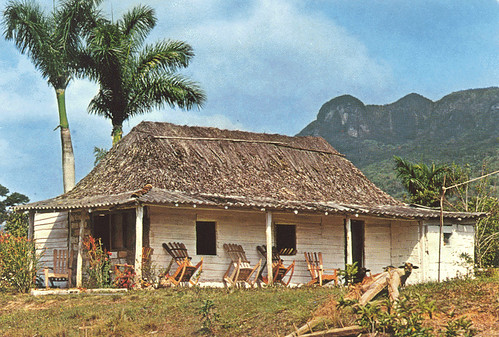
In this community on the "other" side of the tracks, I learned early on, that the only homes we were allowed to build were the shack-type homes with thatched roofs that defined our living quarters. Sewer, running water, electricity, schools, jobs, hospital or medical services were limited to people living on the "other" side of town.
What we did have was a pervasive infant mortality due primarily to preventable diseases that touched the lives of every family. There were rampant pre and post partum deaths; hunger and malnutrition seen predominantly in children with their disproportionate heads and distended abdomens, overflowing with such a variety of intestinal parasites sufficient to produce our own Atlas of Parasitology. Another common landmark was the infamous gully with its putrid drainage winding through our neighborhood.
The only schools in our community of approximately 8-10,000 people, were two or three mock-classrooms of 10-20 children in the living room of those slightly more enlightened members of our community.
Two churches had what could be qualified as small schools, with approximately 40 children each. Because of our teachers’ own limited education, the level of training by those who were able to stay through the entire school program (3-4 years) was the equivalent of a low third grade.
Unbelievable as it may sound today, most of the kids could not stay in school, either because their parents could not afford it or their helping hands were already required on the plantation. As a direct result of this horrendous environment, our community, and tens of similar ones dispersed through what was then the provinces of Camaguey and Oriente, did not produce in 60 years a single person who had achieved a mid level or higher education. An exception was a lady who was able to complete nursing school, only because her parents had the vision and could afford to send her back to Jamaica.
The only jobs available was in the zafra, the 4-5 months sugar harvest, which was virtually slave labor, because it was not only the lowest paying job, but it also kept the people in perennial debts: whatever income you made last year would be credited to debts incurred this year. This practice was so pervasive that thousands of workers never saw or received money, they would only receive promissory notes -VALES- from the landowners, who were often the same owners of the stores. That is why, 10-12 year-old boys went off to work in the fields, while girls in the same age group became maids.
My grandfather was among the fortunate few, because, as an orderly in the United Fruit Company's hospital, he had a year round job paying 50 cents per day.
There were always people sitting in my backyard, waiting for Georgy to get off his job. Some suffered from diarrhea, vomiting, fever or any sort of injuries. He would cleanse their wounds or give them medication he stored in a coffin-like cabinet he kept in his bedroom. As I pieced these events together, I concluded that this honorable man, who preached values to us, was forced by the brutal society in which he lived, to steal from his workplace, in order to serve those who were deprived of the most basic means of survival.
What can we say about the psychological trauma endured by unfortunate mothers, trapped in abusive relations, domestic violence and occasional life threatening situations without anywhere to go, forced to live this hazardous existence as the only means of feeding their hungry children.
For these and so many other reasons, none of us had to flock to South Africa to see what Apartheid was all about. We were born, lived and many died in our own Soweto! (AfroCubaWeb.com)
It was the Cuba of this era that many older Cubans in Miami remember so fondly with such deep nostalgia.I often wonder as I sit in a restaurant or a church in Miami surrounded by elderly Cubans who were at or near adulthood when they left the island in the late 1950's and early 1960's how different they are from white Southerners in this country of the same generation - especially when the similarities are so apparent.
I remember writing the comments that I was asked about. I remember it very well. I remember where I was sitting and what the weather was like. I also remember the cloud that my consciousness was in when I typed those statements.
At the time, I was still very much under the malicious influence of lies and distortions that is almost unavoidable in modern Miami.
Many - if not all - of the statements I made about Fidel Castro and race were influenced by my experiences growing up in one of the most bigoted communities ever known to one of the most bigoted countries history has ever known. I have always tried to say - here in this country supposedly built upon the free and respectful exchange of ideas, opinions, and experiences - that Cuban racism is every bit as virulent as what humanity saw in South Carolina in the 1820's, Mississippi in the 1950's, South Africa in the 1970's, and Washington, D.C. from 1789 to present. I naively thought it only natural that a white Cuban in Cuba would be just as racist as the white Cubans I knew in Miami.
Thus was my narrow-minded lack of consciousness when I read Castro, the Blacks and Africa by Carlos Moore. Moore was the man that translated for Fidel Castro during the Cuban leader's legendary visit to Harlem and the Theresa Hotel in September, 1960.
I was primed for the misrepresentations contained therein and I swallowed them all and passed them along in the only manner one can pass along that which has been swallowed: with the foul stench of intestinal refuse.
Growing up in Cuban Miami during the 1970's and early 1980's, I was taught like other Cuban-American children in South Florida a distinct and dysfunctional version of the old American adage "If you don't have something nice to say about someone, don't say anything at all." The way that saying works in the ultra-rightist, reactionary, intolerant den of democratic inequity is as follows:
"If you don't have something nasty and hateful to say about Fidel Castro, don't say anything at all."
Anything else can run one the very real risk of being branded a Fidelista. That is a very serious concern in a community that openly and proudly harbors several anti-Castro terrorist organizations and, thus, has a history of bombings and the like.My worldview was tinted by that dogmatic brain-washing (heavy on the bleach) until 26 March, 2000 when I had the good fortune of encountering the indomitable Dr. Alberto Jones, a generous Guantanamero, in the historic chapel of my alma mater.
Dr. Jones is a fascinating man whose energy belies his actual age. A defiantly and politely proud patriot, he also takes great pride in his Jamaican ancestry. I have taken great pride in passing along quite a few of Dr. Jones' columns and essays over the years.
Among the things I am grateful for about our friendship, the one thing that stands out the most is the opening of what is an ever-increasing devotion to freethinking and truth seeking.
A price tag cannot ever be put on that gift and I will be ever grateful for it.
The times when I have heard an African-American express any opinion about Fidel Castro, most of the time, the opinion that is expressed is one based on that individual’s perception of a certain significant level of respect he or she has for the Cuban leader. This perception of Castro is often muddied by the incessant and confusing demonizing of him and his initiatives as practiced by both this country’s corporate media and successive administrations in Washington, D.C. Thus, the question that logically follows is “what are we missing about Castro when it comes to skin color?”
To get a good idea about the degree to which one’s view of Castro "as a person whose feelings towards" African-Americans and humanity as a whole is justified, I suggest going straight to the horse's mouth.
The easiest way to do that is to refer to his speeches.
It is easy to demonize someone that one doesn't allow others to hear. Of course, that is if the person one is trying to demonize is not a demon (conversely, the best way to demonize an actual "demon" is to just let him/her talk with an audience).
The more and more I read what I can find of Castro's writings and oratory, the more I can see why there are so many people (most of whom are outside of the stifling influence of U.S. corporate-owned media) that - at minimum - respect him and - at other degrees - practically idolize him.
Living in this country, I have relatively little access to Castro’s speeches but the transcripts from a speech to the United Nations in 1979 on behalf of the Non-Aligned Movement; a speech given in Kingston in 1998; and his legendary courtroom obra maestra from the 1950’s that is better known by its closing line, “History Will Absolve Me” are works I have been impressed by.
The current revolution that Castro has led is a throwback to the original Cuban Revolution of the 19th century. This revolutionary struggle was quite unique and, by all accounts I am currently aware of, the first of its kind in that its philosophical framework stressed the importance of being a struggle that transcended the artificial and fictious constructs of racial and ethnic divides. In fact, racism was considered to be "unpatriotic" (although too many instances of "unpatriotic" acts and attitudes hobbled the revolution in many instances). This revolution also maintained that, as José Martí wrote, "exclusive wealth is unfair."
The beginnings of this struggle are also interesting to note. When an American is asked, "What do you celebrate on the Fourth of July?" the indoctrinated response is "INDEPENDENCE DAY!" (It is this writer’s hope that Americans familiar with Frederick Douglass’ famous views on this “holiday” will appreciate what follows).
Every American school child is taught that the Declaration of Independence was written by Thomas Jefferson whom every American school child is asked to forget was a slave-holding aristocrat.
If the same standard is applied to Cuba, then Cuba's Independence Day is October 10th, 1868.
On that warm autumn day near the eastern Cuban city of Bayamo, slave-holding plantation owner Carlos Manuel de Cespedes had the bell at the Big House rung in the tradition of all slave cultures in the Americas to summon everyone to hear some big announcement. That "big announcement" was that, from that day forward, Cuba would be a free and sovereign nation and, since no nation could be free so long as any of its children was enslaved, de Cespedes instantly emancipated the human beings that he previously held as property.
Thus, the Cuban revolution accomplished in one moment what the American and French revolutions failed to do - largely because the latter pair chose not to do. While Jefferson wrote that "all men are created equal" and Lafayette suggested a Universal Rights of Man, de Cespedes actually put into irrevocable action the very same ideas that the very laws of humanity demand.
As one can see, the parallels between the American and Cuban revolutions end rather quickly.
October, 1868 set into motion what became the definitive and defiant anomaly of the Victorian Age. While Europe and the United States were putting the macabre and sadistic tenets of social Darwinism (the "scientific paradigm" that was in vogue at that time among learned and civilized men of culture - read that to mean white men – which spoke so self-righteously of superior races and inferior races designed to justify modern colonialism) into brutal and avaricious practice in Africa and Asia and western North America, Cuban revolutionaries set out to drive Spain (the originator of the various modus operandi of modern colonialism) into the Caribbean Sea.
There were no more master and slave - only citizens. To be racist was to be unpatriotic - a traitor to the homeland. Black, white, Cantonese, and mixed-race Cubans rose in righteous rebellion against the Spanish crown and all of the oppressive and dysfunctional institutions it so callously imposed upon Cuba. As was said during the thirty-year struggle for independence, the blood of both white and black patriots spilled on the field of battle fighting for Cuba intermingled to fertilize the soil of freedom.
To have a revolutionary ideology (that at times manifested itself almost as a radical theology) which not only spoke and wrote of the brotherhood of all humans but also acted upon it (over 70% of the officer corps of the Army of Independence was "of color") was something that ran in the face of all that was reassuring to Euro-centric concentrations of political, economic, social, and military power.
This war of independence was fought on and off for the next thirty years after the “Grito de Yara” in October of 1868 (just three years and a few hundred miles removed from Paul Bogle’s march on the court house in Morant Bay).
This takes us back the question posed the prompted this humble answer.
For Castro and many Cubans on and off the island, the current revolution is a continuation of that first struggle to throw off the suffocating chains of colonialism for the improvement of life for all Cubans.
To get a better idea about the degree to which one’s view of Castro "as a person whose feelings towards" humanity as a whole is justified, I suggest going straight to the path of the horse's hoofprints.
The best way to do that is to refer to Cuba’s policies, programs, and actions.
Dr. Jones has written that Cuba has produced more Black doctors in the past forty years than Jamaica has in four hundred years.
Cuba also trains - for free - medical students from Haiti, Sub-Saharan Africa, and Latin America.
The only "catch" is that graduates do not go back to their homes to buy a garage full of Mercedes Benz' but, instead, work according to the Hippocratic Oath to heal people for the sake of healing.
This offer has been extended to African-American students and has been on the table for years. Naturally, very few in this country have taken advantage of this opportunity because very few in this country are aware of it (one notable exception is Cedric Edwards, a native of Slidell, Louisiana who just completed the program, making him the first African-American to do so).
The lessons for Americans should be apparent. So should the possibilities.
To get a better feel for the lessons and the possibilities, let us examine the “post-colonial” Caribbean reality that begat the ongoing current chapter of the Cuban revolution.
Fulgencio Batista was another manifestation of that sad Latin American institution of the caudillo or strong man, the Banana Republic thug who was able to hold onto his impoverished fiefdom in the Yankee empire largely via the support of American business interests.
Research Latin American history after the economic and military rise of the United States and one will find a wide array of degenerates with one thing in common: they stayed in power for as long as they were on good terms with United Fruit, Dole, Hershey, et al.
With the triumph of the Bolshevik Revolution in Russia and the subsequent attention given to growing left-of-center economic and political movements in the world, the United States found a justification for supporting blatantly brutal dictatorships in its own tranquil backyard oasis bereft of democratic values and traditions. While the American people were being told that these regimes were anti-communist at a time when anything red was automatically connected directly with the forces of evil, the reality of U.S. rationale behind the protection of these tyrannies was phrased best by Franklin Roosevelt in his assessment of the Dominican Republic's longtime despot Rafael Trujillo:
"He may be a son-of-a-ibtch but he's our son-of-a-itbch!"
That infamous statement of rare American political frankness can easily be applied to miscreants such as Ubico in Guatemala, Pérez Jimenez in Venezuela, Somoza in Nicaragua, Strossner in Paraguay, Machado in Cuba, Duvalier in Haiti just to name but the more notorious.
Batista, like many of the other caudillos in Latin America, actually bore the mantle of progressive redeemer when he ousted the cruel Gerardo Machado, a butcher described by Time magazine on its cover as "The Cuban Mussolini." The realities, however, of the old maxim that says POWER CORRUPTS soon kicked into gear and Batista started earning comparisons between him and the man he sent into exile in the early 1930's.
Batista personally invited the American Mafia vis-à-vis Meyer Lansky (the Jewish Godfather) to overhaul the casinos in Havana. If vice was easy to come by in Cuba before, it soon became almost inescapable as contemporary accounts of the period seem to universally state that anything could be bought in Havana. Thus, Cuba became a giant floating whorehouse seemingly existing only to cater to every perversion imaginable to Americans of every ilk and persuasion.
The de facto brothel status of Cuba did not only apply to casinos and bars and houses of ill repute. Most of the infrastructure of Cuba's bustling economy was foreign-owned and/or -operated - mostly by American corporate interests. The vital utilities (telephone, electricity), the rail lines, the arable soil, et al was in the firm control of American-owned (and Defense and State Department-protected) transnationals.
Since Cuba was operating as a modern plantation, it served that not only the absentee landowners reaped egregious financial benefits but also a trusted elite of natives made small fortunes as well. Indeed, on this plantation, the house Negro was not only relatively affluent but he was (thanks to the dysfunctional complexities of Spanish racism in Cuba) also genuinely white.
Naturally, even the most impressive profit margins ultimately are finite and avarice will only allow for so much wealth to be "shared." So, as is always the case on any plantation, there was literally nothing left to give to those whose efforts generated the huge chunks of black in the ledgers but the monetarily worthless commodities of grief and misery.
From Dr. Jones:
In this community on the "other" side of the tracks, I learned early on, that the only homes we were allowed to build were the shack-type homes with thatched roofs that defined our living quarters. Sewer, running water, electricity, schools, jobs, hospital or medical services were limited to people living on the "other" side of town.
What we did have was a pervasive infant mortality due primarily to preventable diseases that touched the lives of every family. There were rampant pre and post partum deaths; hunger and malnutrition seen predominantly in children with their disproportionate heads and distended abdomens, overflowing with such a variety of intestinal parasites sufficient to produce our own Atlas of Parasitology. Another common landmark was the infamous gully with its putrid drainage winding through our neighborhood.
The only schools in our community of approximately 8-10,000 people, were two or three mock-classrooms of 10-20 children in the living room of those slightly more enlightened members of our community.
Two churches had what could be qualified as small schools, with approximately 40 children each. Because of our teachers’ own limited education, the level of training by those who were able to stay through the entire school program (3-4 years) was the equivalent of a low third grade.
Unbelievable as it may sound today, most of the kids could not stay in school, either because their parents could not afford it or their helping hands were already required on the plantation. As a direct result of this horrendous environment, our community, and tens of similar ones dispersed through what was then the provinces of Camaguey and Oriente, did not produce in 60 years a single person who had achieved a mid level or higher education. An exception was a lady who was able to complete nursing school, only because her parents had the vision and could afford to send her back to Jamaica.
The only jobs available was in the zafra, the 4-5 months sugar harvest, which was virtually slave labor, because it was not only the lowest paying job, but it also kept the people in perennial debts: whatever income you made last year would be credited to debts incurred this year. This practice was so pervasive that thousands of workers never saw or received money, they would only receive promissory notes -VALES- from the landowners, who were often the same owners of the stores. That is why, 10-12 year-old boys went off to work in the fields, while girls in the same age group became maids.
My grandfather was among the fortunate few, because, as an orderly in the United Fruit Company's hospital, he had a year round job paying 50 cents per day.
There were always people sitting in my backyard, waiting for Georgy to get off his job. Some suffered from diarrhea, vomiting, fever or any sort of injuries. He would cleanse their wounds or give them medication he stored in a coffin-like cabinet he kept in his bedroom. As I pieced these events together, I concluded that this honorable man, who preached values to us, was forced by the brutal society in which he lived, to steal from his workplace, in order to serve those who were deprived of the most basic means of survival.
What can we say about the psychological trauma endured by unfortunate mothers, trapped in abusive relations, domestic violence and occasional life threatening situations without anywhere to go, forced to live this hazardous existence as the only means of feeding their hungry children.
For these and so many other reasons, none of us had to flock to South Africa to see what Apartheid was all about. We were born, lived and many died in our own Soweto! (AfroCubaWeb.com)
It was the Cuba of this era that many older Cubans in Miami remember so fondly with such deep nostalgia.I often wonder as I sit in a restaurant or a church in Miami surrounded by elderly Cubans who were at or near adulthood when they left the island in the late 1950's and early 1960's how different they are from white Southerners in this country of the same generation - especially when the similarities are so apparent.
Tuesday, September 06, 2005
Wolves in Sheep's Clothing: A Look at the Patron Saint of Progressive Liberalism
For liberal democrats, few names evoke greater profound reverence when the subject of civil rights arises than the patron saint of the ultra-liberal Midwestern American: Hubert H. Humphrey.
Humphrey's reputation as a champion for all Americans is so great that they named a professional sports stadium after him, an entire school of public affairs, and even a civil rights award.
Some of his quotes are wonderfully crafted phrases evoking the truest democratic ideals:
"What do we want for people? Human dignity, personal expression and fulfillment, justice, freedom."
Wow....
"When we say, 'One nation under God, with liberty and justice for all', we are talking about all people. We either ought to believe it or quit saying it ."
Awesome....
"I am not here to judge whether people are locked in poverty because of themselves or because of the society in which they live. All I know is that they are there and we are trying to do something about it."
Inspiring....
"We cannot use a double standard for measuring our own and other people's policies. Our demands for democratic practices in other lands will be no more effective than the guarantees of those practiced in our own country."
Beautiful words of liberty!
Yes, so much of what forms the base for the special place for Northern Liberals to attack and critique all that is wrong in America can be found in the timeless inspiration of Hubert H. Humphrey.
That is, of course, until we look at 1964.
Blacks trying to end segregation in Mississippi carried their cause to the 1964 Democratic National Convention. They demanded that their mostly black delegation replace Mississippi's all-white group at the Atlantic City, New Jersey gathering. The 36-year-old man given the job of helping broker a compromise was then-Minnesota attorney general Walter Mondale. [Five years ago] in Minneapolis, Mondale recounted the confrontation. He invited to the event several of those who bitterly opposed the compromise.
Lawrence T. Guyot, Jr. was a field organizer for the Student Nonviolent Coordinating Committee in Mississippi in 1964 when he was elected chairman of the Mississippi Freedom Democratic Party. He was selected to be among the challenge delegation to Atlantic City, but was arrested on charges related to a demonstration eight months earlier.
Mondale says President Lyndon Johnson saw the Mississippi Freedom Democratic Party's demand to replace the all-white delegation from their state as a threat to his bid for the presidency.
Mondale: He was afraid that seating the Freedom Democrats would incite a walkout of southern and border states and hand the election to Barry Goldwater. The confrontation made headlines because the challenge mounted by the Mississippi Freedom Democratic Party was broadcast on national television.
Hamer: My name is Mrs. Fannie Lou Hamer.
Hamer's accounts of Mississippi blacks being beaten, arrested, and killed for trying to register to vote shocked people. Many Americans were unaware of Mississippi's laws which forced separation of the races.
Hamer: Is this America, the land of the free and the home of the brave where we have to sleep with our telephones off the hook because our lives been threatened daily because we want to live as decent human beings in America?
Hamer and her fellow Freedom Party members won support at Atlantic City from national party delegates who were ready to vote to seat them.
Freedom Party founder Lawrence Guyout Jr. says that set off some hardball lobbying of delegates from supporters of Lyndon Johnson.
Guyout: A delegate from California was called and told, "Look, your husband can be a federal judge, just stop voting for the Freedom Democratic Party."
The politicking taking place in hotel rooms away from the convention floor was also bare-knuckled.
The Reverend Edwin King, a white minister and a founder of the Freedom Democratic Party remembers the meeting with Hubert Humphrey, United Auto Workers president Walter Reuther, Martin Luther King Jr., and a handful of others. King says Humphrey described Fannie Lou Hamer as an unacceptable spokeswoman for black people.
King: And then Mr. Humphrey said, "Look at her the way she dresses, her grammar, this is not the kind of person white America needs to see representing black people."
King says Humphrey's words may have been his own, President Johnson's or possibly even the view of other blacks concerned about the momentum of the civil rights movement. He recalls when Martin Luther King Jr. said he favored seating the Mississippi Freedom Party, union president Walter Reuther turned in King's direction. King: And then to Martin almost wagging his finger in Martin Luther King's face, he said, "Remember who pays for you."
Reuther, King says, was referring to union money donated to pay the bail of jailed civil rights workers.
After four days of talks, Walter Mondale says, the compromise offered the Mississippi Freedom Party was two at-large delegates who they would not be allowed to choose and a promise the Democrats would not accept segregated delegations at future conventions. The compromise was rejected by both sides.
Fannie Lou Hammer shouted, "We didn't come all this way for no two seats!" And the all-white Mississippi delegation walked out. Bitterness deepened when it was learned Johnson had more than two dozen FBI agents and paid informants tailing the Freedom Party throughout the convention. link http://news.minnesota.publicradio.org/features/200002/11_olsond_mondalelectures/
Wait, there's more:
In the summer of 1964, the Mississippi Freedom Democratic Party, or "Freedom Democrats" for short, was organized with the purpose of challenging Mississippi's all-white and anti-civil rights delegation to the Democratic National Convention of that year as not representative of all Mississippians. Hamer was elected Vice-Chair. The Freedom Democrats' efforts drew national attention to the plight of African-Americans in Mississippi, and represented a challenge to President Lyndon B. Johnson, who was seeking the Democratic Party's nomination for a second term; their success would mean that other Southern delegations, who were already leaning toward Republican challenger Barry Goldwater, would publicly break from the convention's decision to nominate Johnson — meaning in turn that he would almost certainly lose those states' electoral votes in the election.
Hamer, singing her signature hymns, drew a great deal of attention from the media, enraging Johnson, who referred to her in speaking to his advisors as "that illiterate woman".
Hamer was invited, along with the rest of the MFDP officers, to address the Convention's Credentials Committee. She recounted the problems she had encountered in registration, and the ordeal of the jail in Winona, and, near tears, concluded:
"All of this is on account we want to register [sic], to become first-class citizens, and if the Freedom Democratic Party is not seated now, I question America. Is this America, the land of the free and the home of the brave where we have to sleep with our telephones off the hooks because our lives be threatened daily because we want to live as decent human beings - in America?"
In Washington, D.C., Johnson panicked, calling an emergency press conference in an effort to divert press coverage away from Hamer's testimony; but many television networks ran the stunning speech unedited on their late news programs that night. The Credentials Committee received thousand of calls and letters in support of the Freedom Democrats.
Johnson then dispatched several trusted Democratic Party operatives to attempt to negotiate with the Freedom Democrats, including Senator Hubert H. Humphrey (who was campaigning for the Vice-Presidential nomination), Walter Mondale, Walter Reuther, and J. Edgar Hoover. They suggested a compromise which would give the MFDP two seats in exchange for other concessions, and secured the endorsement of Martin Luther King and the Southern Christian Leadership Conference for the plan. But when Humphrey outlined the compromise, saying that his position on the ticket was at stake, Hamer, invoking her Christian beliefs, sharply rebuked him:
"Do you mean to tell me that your position is more important than four hundred thousand black people's lives? Senator Humphrey, I know lots of people in Mississippi who have lost their jobs trying to register to vote. I had to leave the plantation where I worked in Sunflower County. Now if you lose this job of Vice-President because you do what is right, because you help the MFDP, everything will be all right. God will take care of you. But if you take [the nomination] this way, why, you will never be able to do any good for civil rights, for poor people, for peace, or any of those things you talk about. Senator Humphrey, I'm going to pray to Jesus for you."
Future negotiations were conducted without Mrs. Hamer, and the compromise was modified such that the Convention would select the two delegates to be seated, for fear the MFDP would appoint Hamer.link http://en.wikipedia.org/wiki/Fannie_Lou_Hamer
There is still more ...
Nowhere does her spirit come through more clearly than in Mills' account of the 1964 challenge Hamer and others leveled at the Democratic delegation sent to the presidential convention in Atlantic City. The challengers persuasively claimed that they represented thousands of disenfranchised African-Americans who had been denied their right to participate in the political process. The Democratic presidential candidate, Lyndon Johnson, and his running mate, Hubert Humphrey, Mills recounts, dragged their feet on addressing the challengers' claims, only belatedly offering a weak compromise that Hamer and some others fiercely opposed.
"I question America," Hamer memorably said during hearings on her group's challenge of the white-only delegation. link http://http://www.amazon.com/exec/obidos/tg/detail/-/0452270529/002-7179445-2504030?v=glance
We're not quite done yet ...
While the Freedom Democratic Party buses headed for Atlantic City, where the convention was held along a garish boardwalk, LBJ plotted to employ the party’s leading liberals to undermine the FDP challenge. Hubert Humphrey, the hero of the 1948 civil rights debate, was dispatched to stop these Mississippi black people from taking the promise too seriously. The Humphrey plan encountered trouble as plain Democratic delegates from northern states were moved by the eloquent testimony from sharecroppers like Fannie Lou Hamer. Humphrey lectured the arriving Freedom delegation that LBJ “will not allow that illiterate woman to speak from the floor of the convention” .
Walter Reuther, leader of the United Auto Workers, was flown by private jet to help quell the Freedom challenge, hoping that Johnson would nominate Humphrey as vice president. “We can reduce the opposition to this to a microscopic fraction so they’ll be completely unimportant”, he pledged.
The Humphrey compromise failed to meet the test of either participatory democracy or political realignment. It boiled down to offering two delegate-at-large seats to the Freedom Democrats while seating the official segregationist party and promising to reform the process four years later. “We didn’t come all this way for no two seats”, said Mrs. Hamer. We came to bring our morality to politics, not politics to our morality, said Bob.l i n k http://http://www.tomhayden.com/socmov2.htm
Some civil rights hero, ¿huh?
At the moment of truth, when a group of brave Black citizens fought to pull themselves up from the muck of ignorance that the Dixicrat establishment had tried to bury them under vís-a-vís no social services whatsoever (quality education, quality health care, quality housing, equality before the law) and exercise their Constitutional right to have their voices heard in selecting representatives from their home state, Humphrey saw only his chance at Blair House threatened and attacked accordingly.
Hubert H. Humphrey
The "H" stands for "hypocrite."
Saturday, May 21, 2005
Rethinking Rabbani’s Reality
I have never liked the taste of boiled iced tea. The lack of sweetness is not the problem. Many drinks that I enjoy (water is at the top of the list) are not sweet. No, it is the shocking and lingering bitterness of how many Americans make their iced tea that always stops me in mid-sip.
Oft times, I tried to do the Yankee tea like some of those nasty liquid “medicines” of my childhood: drink it all down so fast that my taste buds have minimal time to object. *Neglecting to remember, of course, that the sensory job of my “buds” is an important “warning system.” However, this tactic has had very, very limited success with boiled tea.
Yech!
As I have grown older and spent more time in Texas, I have had more encounters with this unpleasant elixir of the North. These encounters have caused me to realize something about human nature: the more a person has to deal with something that is initially repulsive to him/her, the more he/she becomes accustomed to and tolerant of that repulsive something.
Felix Ungars who have to without bathing for too long become accustomed to, tolerant of (albeit begrudgingly) of the smell.
Men and women who do not love their spouses become, after several years of matrimony, accustomed to, tolerant of sharing with the previously unwanted a bed.
All of this (and much more) is the result of one of the most important aspects of human nature that has been virtually instrumental to our species’ survival after many millennia: resiliency via adaptation.
Indeed, it is the ability to “improvise, adapt, and overcome” that has kept us on this planet thriving to the point where we are about to destroy the planet that, thus far, has not been able to destroy us.
When I was little, my father – who was a police officer in Miami for 13 years before his death – took my brothers and I to peek inside of an empty holding cell at the city’s old police headquarters (the site of which is now a shiny new Winn Dixie). The peek lasted only a few seconds but I remember that it was cold, dark, and frightening. I remember the drop in my chest when the awesome, steely thud of the hatch shutting closed was heard – and I was on the outside. It scared the absolute isht out of me and it still does thirty years later.
The “Scared Straight” documentary of the mid-seventies offered the same thesis: the initial shock of incarceration is enough of a deterrent to prevent the normal human being from committing (or recommitting) any jailable offense in the future.
But what happens when you leave a human being - a resilient and adaptable creature, the most resilient and adaptable creature – behind bars for too long? Won’t they “get used to it”? Won’t prison then become something that no longer serves as a deterrent? If so, then are we trying to punish crime or prevent crime?
Whereas I grew up with the logic that appropriately-executed punishment is meant to prevent crime, the above rationale presents them, not as steps in the same process, but as completely different, almost adversarial processes.
Mumia Abu-Jamal asks “why do we call it ‘corrections’?”
I think of the accounts of men and women who spent so much time – too much time – in a “correctional setting” that they became so accustomed – too accustomed – to prison “life” that they were unable to exist in a normal setting outside of jail. Sadly for them, the prison stopped being shocking and, instead, became a normal setting.
I spent years training and licensing foster parents in Miami using, as our primary training tool, the state-required Model Approach to Partnerships in Parenting curriculum (designed and copyrighted by the Child Welfare Institute in Atlanta). Of the ten “meetings” we conducted for the training of prospective foster, adoptive, and shelter parents, the most popular was meeting number five. This particular meeting’s focus was discipline.
Among the many vital points we covered during this mandatory meeting were (A) the true definition of the “discipline,” (B) proper execution of different behavior modifications, and (C) why certain “punishments” (behavioral “interventions”) that were “fine” and “okay” for “normal, well-adjusted “ people were not appropriate for people with histories of abuse, abandonment, and neglect.
According to the MAPP curriculum, “discipline” is defined as the method to teach a human being how to conduct him/herself in a manner that is socially-appropriate, in a way that will not cause the individual to alienate him/herself from his/her peers.
There is no mention of “punishment” in the definition of discipline. This is because punishment is not a part of discipline like a heart or a brain is a part of a person. The purpose, the definition of discipline is to educate and motivate a person to do “the right thing.” How one educates and motivates varies. However, it is important to note that rewarding of appropriate behavior and role-modeling of appropriate behavior are, according to MAPP, the two most effective ways of teaching some one to act in a socially-appropriate manner. In short, rewards and role models are the best disciplinary tools.
When rewards and role models do not prevent someone from running afoul of what is socially-appropriate, punishments come into play. Because the MAPP course was designed for foster parents, many of the punishments discussed during the fifth meeting are geared towards juveniles. One punishment discussed is “time-out.” Like the penalty box in hockey, time-out is designed to remove a child from a setting in which the child has made a wrong choice. Recognizing that leaving a person in the same physical and time setting in which a bad decision was made could escalate into more bad decisions, time-out is meant to allow the child in question to take a “time-out” and reflect on the error for the purpose of correcting said error and redeeming him/herself within a reasonable and realistic amount of time.
Because “time-out” is meant to foster better decision-making (and coping mechanisms), it is very important that (A) the child be afforded an appropriate environment free of stressors in which he/she can clearly reflect on errors and develop corrections and (B) then be allowed to redeem him/herself as soon as possible.
The basic standard for determining how long a child should remain in time-out is one minute per each year of the child’s age minus one. The reasoning for this standard is simple: if a child spends too much time in time-out, the child forgets the feelings associated with the error (if not the error itself) and thus the motivation to “do better” is diminished (if not lost altogether). In turn, the disciplinarian will have lost his/her own initiative and nothing positive is learned, nothing positive is gained by either party.
The highly-effective MAPP training (which is used by numerous states nationally and several countries internationally) also emphasizes the need to be always cognizant of the fact that disciplining a child in care is not the same as disciplining a child who has not suffered the clinically-documented trauma of coming into state custody. Many MAPP trainees (and trainers) experienced many punishments (including, but not limited to, corporal punishment) and – for the most part – they are all very well-adjusted as evidenced by their collective socially-appropriate behaviors. But, because differences in variables can – and often do – impact the sum/products of equations, it must be remembered that disciplining an individuals who have not enjoyed certain benefits taken for granted by some strata of our society will not necessarily yield the same socially-appropriate results.
For example, spanking a child or sending that child to bed with no dessert is not typically traumatic in a stable and nurturing environment. The child trusts the caregiver(s) enough to know that he/she/they is/are not trying to kill him/her. A child from an unstable and hostile setting could very easily interpret (and sometimes justifiably) those acts as being sinister and, therefore, unsettling.
In other words, discipline is ineffective if the one being disciplined is fearful and distrustful of the disciplinarian.
Returning the current sentencing practices of the criminal justice system in this country, are we really correcting the socially-inappropriate actions of people convicted of crimes with long sentences or are we creating a population that, via the inherent human instinct to adapt, no longer shocked? Further, if the latter is the case, are we contributing to a cycle of societal dysfunction via the creation of an increasingly institutionalized frame of bestial reference?
Would not a quick, intense intervention (such as the six-week “boot camps” for teens or jail terms measured in months and not years) be just as effective in scaring an offender straight as a splash of cold water in the morning is effective in waking a still drowsy person?
If one were to jump into a cold swimming pool, the shock would likely elicit yells and brief trauma to the central nervous system. If one, however, stayed in the pool, the body would eventually adjust to the change in temperature. The water’s temperature would not change; the person’s body would adjust to the temperature.
When it comes to sentencing, the writer believes that society as a whole is being done an egregious injustice when other human beings are left in the pool too long.
This is not “correction” – it is saturation.
Subscribe to:
Posts (Atom)